
2026 Best Types of Welding Screens for Global Buyers?
Choosing the right welding screens in 2026 requires more than comparing prices or fabric colors. Global buyers face different workshop layouts, welding processes, worker densities, and compliance expectations. A screen suitable for a small repair bay may fail in a busy fabrication plant. The details matter.
Welding safety specialist Chris Smallbone is widely associated with practical hazard control. His message is simple: “Control the hazard at its source, before it reaches people.” This principle supports every decision in our guide. Buyers should examine ultraviolet protection, flame resistance, opacity, frame strength, mobility, ventilation, and replacement access. PVC strip curtains may suit fixed production areas. Folding screens can help maintenance teams move between workstations. Heavy-duty curtains may perform better around frequent grinding and high heat.
Color also deserves attention. Darker shades can reduce arc glare, while lighter shades may improve visibility around the work zone. However, shade color alone does not prove protection. Check documented performance, product testing, and supplier traceability. Local requirements may differ. Verify them before ordering.
Some buyers focus too heavily on initial cost. That can be a mistake. A cheaper screen may tear quickly, expose gaps, or require frequent replacement. Yet the most expensive model is not automatically the best choice. Real working conditions decide value. Measure the bay, observe traffic patterns, and consider how often screens will move. We may overlook cleaning and inspection. That deserves more attention. This 2026 guide compares the best types of welding screens for global buyers, while recognizing that one practical weakness remains: product claims still require careful verification.
What Are Welding Screens and Why Do Global Buyers Need Them?
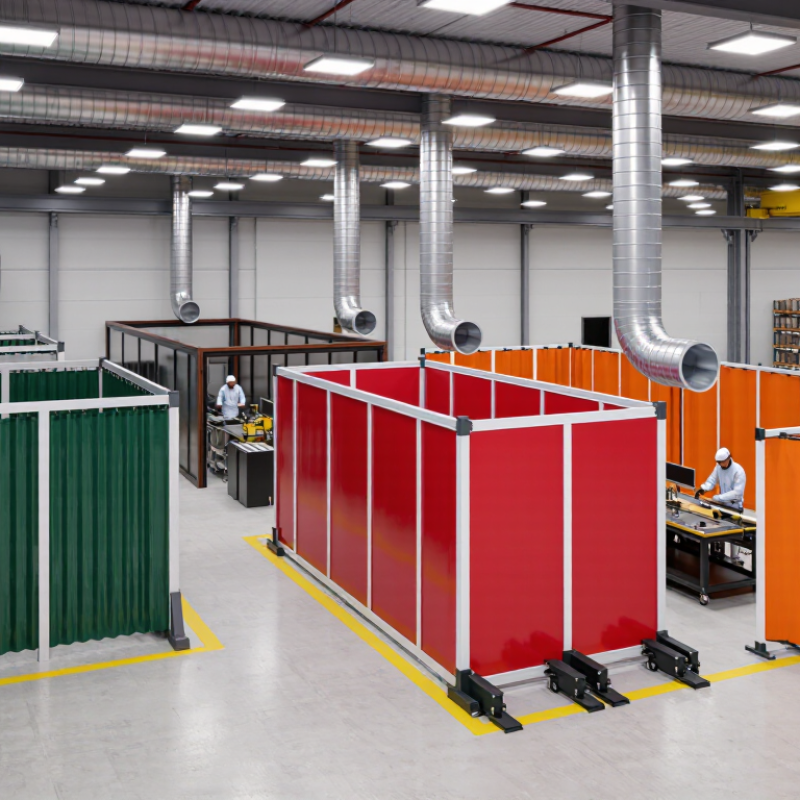
Welding screens are protective barriers placed around an arc-welding area. They reduce exposure to ultraviolet radiation, visible glare, sparks, and flying hot particles. Global buyers need them because nearby workers may face hazards without handling the welding torch. OSHA 29 CFR 1910.252 requires screens or suitable protection around welding operations. The IARC Monographs, Volume 118, also classifies welding fumes as carcinogenic to humans. A screen controls radiation, but it does not replace ventilation or personal protective equipment.
Common choices include fixed panels, portable folding screens, strip curtains, and transparent welding curtains. Opaque panels provide stronger visual separation. Transparent screens support supervision and improve workshop visibility. ISO 25980:2014 specifies requirements for transparent curtains, strips, and screens used during arc welding. Buyers should check flame resistance, screen height, panel stability, color performance, and replacement access. A low-cost screen can still fail when its frame tips, seams open, or the material becomes cloudy. That detail is often overlooked.
Tips: Measure the work area before ordering. Leave safe access for workers and equipment. Match the screen to the welding process and nearby traffic. Inspect tears, discoloration, and loose wheels regularly. Do not assume one screen suits every workshop. Reviewing local risk assessments with a qualified safety professional remains necessary.
2026 Best Types of Welding Screens for Global Buyers? - What Are Welding Screens and Why Do Global Buyers Need Them?
| Welding Screen Type | Typical Construction | Visibility and Light Control | Typical Applications | Key Advantages | Important Limitations | Common Configuration Data | Buyer Considerations |
|---|---|---|---|---|---|---|---|
|
1 Opaque Welding Curtain |
Flexible PVC or coated textile curtain with a solid, non-see-through surface. Commonly supplied with reinforced hems, eyelets, hooks, or a track system. | Blocks direct visibility of the arc and provides strong visual separation. It is normally selected where privacy and maximum shielding from visible arc light are required. | Permanent welding bays, heavy fabrication shops, repair workshops, and areas where several welding operations operate close together. | Strong privacy, good separation between workstations, reduced distraction, and effective control of direct arc flash visibility. | Operators outside the enclosure cannot observe the welding process through the curtain. It can also reduce airflow when installed as a continuous enclosure. | Typical curtain heights range from approximately 1.8 to 2.4 m, with custom widths available. Thickness and surface performance vary by material and application. | Confirm compliance with the applicable welding-screen standard, flame-resistance documentation, temperature rating, hanging method, and cleaning requirements. |
|
2 Transparent or Translucent Welding Curtain |
Specially formulated PVC welding curtain designed to reduce hazardous optical radiation while allowing filtered visibility of activity and movement. | Permits limited visual monitoring while filtering welding light. Shade or optical-transmission performance must be verified from the technical datasheet. | Shared production floors, training areas, inspection zones, and workshops requiring supervision without opening the welding bay. | Better visibility of workers and equipment, improved supervision, and more natural light distribution than fully opaque curtains. | Transparent does not mean safe to view without assessment. It is not a substitute for a certified welding helmet or appropriate personal eye protection. | Common panel widths are about 1.3 to 2.0 m, while heights are often about 1.8 to 2.4 m. Optical shade classifications differ by product. | Request documented spectral transmission or shade information and verify that the product is suitable for the welding processes and arc intensities used. |
|
3 Strip Welding Curtain |
Overlapping vertical strips made from flexible PVC or welding-grade transparent material, suspended from a rail or mounting bar. | Provides filtered light control while allowing people, carts, and materials to pass through the opening more easily than with a solid curtain. | Doorways, material-transfer points, welding-cell entrances, and locations requiring frequent pedestrian or forklift access. | Easy access, reduced draft, flexible opening arrangement, and lower space requirements than hinged or framed panels. | Gaps can occur if strips are incorrectly overlapped, damaged, or displaced. It generally provides less visual separation than a fully closed curtain. | Strip widths commonly range from about 200 to 400 mm. Overlap is selected according to traffic, airflow, and shielding requirements. | Check strip thickness, overlap percentage, suspension hardware, replacement availability, and compatibility with pedestrian or vehicle traffic. |
|
4 Folding Mobile Welding Screen |
Several connected panels mounted on a lightweight metal frame, usually fitted with swivel casters or lockable wheels. | Can be configured as a partial enclosure. Panels may be opaque, translucent, or fitted with welding-grade curtain material. | Maintenance departments, low-volume production, job shops, temporary work areas, and facilities with changing layouts. | Portable, reusable, quick to deploy, and suitable for dividing different work areas without permanent construction. | Stability depends on the frame, wheel locks, panel arrangement, and floor condition. It may be less resistant to strong drafts than a fixed enclosure. | Typical overall heights are approximately 1.8 to 2.1 m. Panel widths are often about 0.6 to 1.0 m each, depending on the design. | Evaluate caster quality, frame corrosion protection, folded storage size, panel replacement method, and resistance to tipping. |
|
5 Fixed-Frame Welding Screen |
Rigid steel or aluminum frame with mounted curtain, mesh, or welding panel. It may be floor-mounted, ceiling-suspended, or integrated into a welding bay. | Offers consistent coverage and controlled visibility. The selected curtain or panel determines optical protection and privacy. | Dedicated welding cells, high-utilization fabrication lines, educational laboratories, and production areas requiring repeatable separation. | High stability, durable installation, predictable enclosure geometry, and suitability for frequent industrial use. | Less flexible to relocate and usually requires installation planning, floor space, and possible building modifications. | Custom bay dimensions are common. Frame finishes may include painted steel, galvanized steel, or aluminum, depending on corrosion and weight requirements. | Review anchoring, fire-safety documentation, access routes, ventilation, emergency egress, and compatibility with overhead cranes or other equipment. |
|
6 Retractable Roller Welding Screen |
Welding curtain housed in a roller cassette or tubular frame and lowered only when welding work is in progress. | Provides an adjustable barrier while keeping the area open when the screen is not required. Curtain optical performance depends on the selected material. | Compact workshops, assembly lines, inspection areas, and locations where permanent hanging curtains would obstruct access. | Space-saving, neat appearance, fast deployment, and convenient separation for occasional welding tasks. | Moving components require inspection and maintenance. The screen may not be suitable for locations exposed to severe impact, sparks, or high heat unless specifically rated. | Available in customized widths and drop lengths. Manual, spring-assisted, and powered operating systems are used in different installations. | Confirm maximum curtain size, operating cycles, mounting load, heat exposure, control requirements, and access for maintenance. |
|
7 Fire-Resistant Welding Screen |
Curtain or panel made from welding-grade PVC, coated fabric, or other material tested for resistance to ignition, flame spread, or hot-particle exposure. | May be opaque, translucent, or transparent. Optical protection and fire performance are separate properties and must be assessed independently. | Heavy fabrication, shipbuilding, repair facilities, construction sites, and work areas with increased exposure to sparks and hot spatter. | Improved protection against sparks and hot particles when correctly selected, installed, and maintained. | Fire resistance does not make a screen indestructible or suitable for direct contact with molten metal. Damaged material must be removed from service. | Fire-test classifications, temperature limits, thickness, and welding-process suitability vary widely. No single rating applies to every product. | Obtain current test reports, installation instructions, flame-spread information, and limitations for the actual welding process and environment. |
|
8 Welding Booth or Full Enclosure |
A complete screened work zone using multiple curtains, rigid panels, a roof section, or a combination of barriers and ventilation equipment. | Provides the highest level of visual separation among common screen arrangements. Optical protection still depends on the selected screen material. | High-volume production, robotic welding areas, certification and training rooms, and processes generating substantial arc light or spatter. | Strong containment, improved workflow organization, better separation of nearby personnel, and easier integration with local exhaust ventilation. | Higher purchase and installation cost. Poorly designed enclosures may restrict ventilation, access, lighting, or emergency evacuation. | Dimensions are project-specific. A practical design should account for operator movement, workpiece size, ventilation paths, door openings, and service access. | Coordinate the screen design with occupational-safety requirements, local exhaust ventilation, fire protection, electrical safety, and emergency exits. |
Related Posts
-
Essential Guide to Welding Screens: Enhancing Safety and Efficiency in Your Workshop
-

The Ultimate Guide to Choosing the Right Welding Screens for Maximum Safety and Efficiency
-
Why You Need Welding Screens for a Safer Work Environment
-
Top Welding Screens for Safety and Efficiency in Your Workspace?
-
2026 Best Welding Screens for Safety and Efficiency?
-
How to Choose the Best Noise Cancelling Curtains for Your Home?
 '
'
