2026 Top Embroidery Sheer Fabric Types for Global Buyers
Embroidery Sheer Fabric is moving beyond occasional bridal decoration. It now supports eveningwear, modest fashion, lingerie, scarves, stage costumes, and premium home accents. Global buyers are therefore comparing appearance, performance, traceability, and landed cost together. The important question is not simply which fabric looks beautiful.
Textile Exchange reported that global fiber production reached about 124 million tonnes in 2023. Its Materials Market Report 2024 projects production could approach 160 million tonnes by 2030. This pressure makes material selection more important, especially when buyers evaluate polyester tulle, nylon mesh, silk organza, polyester chiffon, embroidered voile, and lace. The United Nations Comtrade database also shows the scale of international textile trade, although customs categories do not always separate embroidered sheer constructions clearly. That limitation deserves attention.
This guide examines the leading Embroidery Sheer Fabric types expected to attract global buyers in 2026. It considers drape, embroidery stability, abrasion resistance, colorfastness, needle damage, minimum order quantities, and sampling reliability. Tulle may provide crisp volume, while chiffon offers softer movement. Organza creates structure, but its stiffness can expose uneven stitching. Lace delivers visual richness, yet production consistency may vary between batches.
Real sourcing experience suggests that a fabric swatch is only the beginning. A 30-centimeter sample cannot reveal every washing, packing, or shipping problem. Buyers should request test results and production samples. Recheck the assumptions. Forecasts are useful, not perfect. Regional demand, fiber prices, certification rules, and decoration technology may change the ranking during 2026. Reliable suppliers should explain composition, embroidery density, finishing methods, inspection procedures, and documented environmental claims before purchase decisions are finalized.
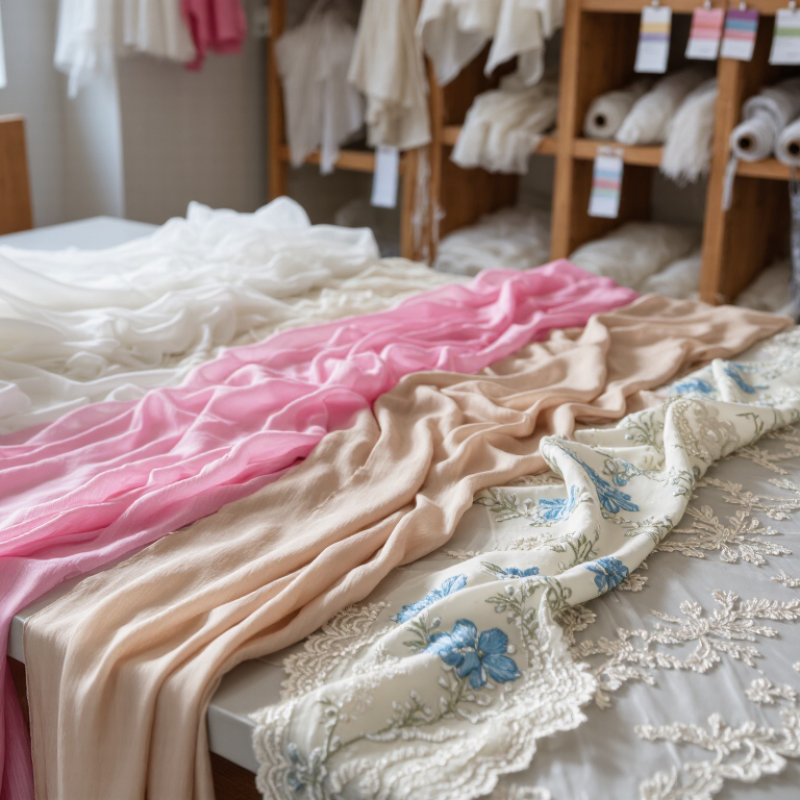
Sheer Embroidery Fabric Defined: 20–100 GSM, Opacity, and Core Terms
Sheer Embroidery Fabric is a lightweight base cloth decorated with stitched patterns. For global buyers, 20–100 GSM usually describes the fabric’s weight per square meter. Lower GSM fabrics feel airy and reveal more skin or lining. Higher GSM fabrics offer stronger coverage and a firmer hand.
Opacity depends on more than GSM. Yarn density, embroidery coverage, thread color, base construction, and lighting all change the visual result. A 30 GSM tulle may look more transparent than a 45 GSM voile. Organza often feels crisp, while mesh feels flexible and open. Lace can appear dense when its embroidery covers most of the surface. Ask suppliers for GSM tolerance, usable width, fiber composition, and close-up photos.
Sample testing matters. Hold the fabric over a printed page and check visibility under daylight and indoor lighting. Some samples surprise me. I have seen identical GSM figures produce different coverage because their stitch layouts were uneven. Buyers should also test snag resistance, shrinkage, colorfastness, seam behavior, and washing performance. Request a small cutting before placing a bulk order. Compare the pre-wash and post-wash appearance. A minor flaw in the first sample may become a major production issue, although not every irregularity affects the final garment. Confidence should come from measured results, not only a product description.
Base-Fiber Types: Polyester, Nylon, Cotton, Silk, and Blended Constructions
2026 Top Embroidery Sheer Fabric Types for Global Buyers
Base-Fiber Types: Polyester, Nylon, Cotton, Silk, and Blended Constructions
For global buyers, base fiber determines how embroidered sheer fabric looks, feels, and performs after shipment. Polyester remains practical for stable mesh, organza, and voile constructions. It resists wrinkles, dries quickly, and holds embroidery detail during repeated handling. However, excessive heat can distort fine filaments. Request heat-setting data and a pre-shipment swatch.
Nylon creates a softer, lighter hand, especially in delicate net and tulle. Its flexibility suits flowing garments, but sharp embroidery edges may encourage snagging. Cotton offers breathability and a natural surface that photographs well in soft light. It can shrink, crease, and absorb moisture. Check dimensional stability after washing. Test before scaling.
Silk provides exceptional luster and fluid drape, yet it requires careful handling. Needle marks can remain visible on very open constructions. Blends often deliver a more balanced result. Polyester-cotton can improve stability while retaining some softness. Nylon-polyester may combine resilience with a smooth touch. No fiber wins always. Blend ratios matter more than the word “blend.” Ask for fiber percentages, GSM, fabric width, embroidery shrinkage, and colorfastness results. I have seen attractive samples fail when the base fabric and thread shrank differently. That overlooked mismatch can ripple the surface after finishing.
Fabric Engineering: Mesh Count, Thread Density, Width, and Embroidery Stability
2026 Top Embroidery Sheer Fabric Types for Global Buyers
Choosing sheer fabric for embroidery requires more than appearance. Tulle, fine mesh, organza, and embroidered net each respond differently under needle pressure. Mesh count shows the number of openings within a measured area. A higher count creates a finer surface, but it may reduce flexibility. Not always.
Thread density also affects stitch control. Closely woven threads can support detailed embroidery and reduce distortion. However, excessive density may make the fabric stiff or cause puckering. Buyers should compare warp and weft density, not rely on fabric weight alone. Small gaps matter. Ask for a technical sheet showing composition, density, finished width, and tolerance limits.
Width must be measured after finishing, because heat and tension can change usable fabric space. For production checks, inspect the selvage, cut a sample, and test embroidery at the planned stitch density. A stable fabric should hold the design without stretched holes, broken edges, or visible waves. Wash and steam tests are valuable for export orders. Results can vary between dye lots, so one approved sample is not enough. In practice, I would request several rolls before confirming bulk production. That step adds time, but it exposes weaknesses early. Some instability remains difficult to predict, especially with very open mesh. Rechecking after packaging is wise.
2026 Top Embroidery Sheer Fabric Types for Global Buyers
Fabric Engineering: Mesh Count, Thread Density, Width, and Embroidery Stability
The chart compares representative engineering values commonly used when screening embroidery-grade sheer fabrics. Mesh count refers to approximate openings per inch, while combined thread density is the total warp and weft threads per inch. Higher stability is generally associated with a more controlled structure and better backing support.
Typical finished widths: soft tulle 150–300 cm, hard tulle 150–300 cm, polyester mesh 150–320 cm, organza 110–150 cm, and net lace base 135–280 cm. Actual specifications vary by yarn size, finishing, stretch, and embroidery backing; production samples should be tested before bulk ordering.
Quality Benchmarks: ISO 105 Colorfastness, Shrinkage, and Flammability Testing
For 2026 buyers, embroidered sheer fabrics should be judged beyond appearance. Tulle, voile, mesh, and organza can look elegant under showroom lighting. Their performance may change after washing, rubbing, or heat exposure.
ISO 105 testing provides useful evidence for colorfastness. Buyers should request washing results under ISO 105-C06, rubbing results under ISO 105-X12, and perspiration results under ISO 105-E04. Ask for test conditions, fabric composition, and color depth. A dark embroidered base may bleed more than a pale ground. Shrinkage testing also matters. Measure length and width before and after washing. A 3% change may be acceptable for some applications, but unstable embroidery can distort the whole pattern. Test the actual finished fabric, not only the plain base cloth.
Tips: Request a pre-production sample with embroidery, backing, and finishing included. Inspect it after one wash cycle. Check needle holes, loose threads, puckering, and color transfer. For flammability, confirm the destination market and end use before selecting a method. Curtains, apparel, and decorative panels may follow different requirements. A laboratory report should identify the test standard, specimen direction, and conditioning process. Do not rely on “fire resistant” wording alone.
I have seen fabrics pass color tests yet fail visually after shrinkage. That gap deserves attention. Keep retained samples from every approved lot. Testing costs less than explaining a distorted border to a global customer.
Global Buying Metrics for 2026: MOQ, GSM Tolerance, Compliance, and Lead Time
Global buyers are comparing embroidered voile, tulle, organza, and mesh by measurable risk, not appearance alone. For sheer fabrics, practical MOQs often range from 500 to 1,000 meters per color. Custom embroidery may require higher quantities. A 30–100 GSM range suits many lightweight applications, while a ±5% GSM tolerance is a workable purchasing benchmark. It is not perfect.
The 2024 Textile Exchange Materials Market Report recorded 124 million tonnes of global fiber production in 2023. Polyester represented about 57% of output, increasing the need for recycled-content evidence and traceability. Buyers should request fiber declarations, colorfastness results, and restricted-substance testing. REACH requirements apply to European sales, while other markets may require different chemical and labeling controls. One certificate rarely covers every destination.
Allow 35–50 days for standard production after approval. Embroidery development can add 7–14 days, especially with dense motifs or unstable tulle. Inspect the first bulk roll for skipped stitches, puckering, shade variation, and edge distortion. A ±5% tolerance may protect production planning, yet it can still change the fabric’s drape visibly. I would reserve 3–5% extra fabric for cutting loss. That allowance is often missed. Supplier capacity, port congestion, and sample revisions can still move delivery dates.

 '
'
