| Settling Tank with Cooling Capability | Separates gross lees and suspended solids by gravity before racking or polishing filtration. | White, rosé, and sparkling base wines; pre-fermentation must clarification. | Prefer smooth 304 or 316L stainless steel, sanitary welds, drainable pipework, spray devices, temperature control, and a suitable headspace-management system. | Clarification performance depends on time, temperature, particle density, tank geometry, and protection from oxygen. Cooling is commonly used to slow unwanted microbial activity. | Drain fully, rinse promptly, use an approved alkaline cleaner, rinse to neutral pH, and apply a validated sanitizer before reuse. Avoid leaving lees to dry on internal surfaces. | Inspect valves, gaskets, temperature probes, pressure/vacuum protection, cooling connections, and weld areas. Verify temperature sensors periodically. | Confined-space entry, pressure or vacuum, CO₂ accumulation, chemical exposure, and slip hazards. Use lockout procedures, ventilation, gas monitoring, and confined-space controls. | Food-contact surfaces should comply with the destination market's applicable food-contact rules. Hygienic design, traceability, chemical labeling, and wastewater controls may also apply. |
| Flotation Clarifier | Uses fine gas bubbles to lift suspended solids and lees to the surface for rapid removal. | Rapid clarification of grape must, especially when processing speed is important. | Use sanitary stainless steel, accessible inspection points, drainable lines, a controllable gas-injection system, and materials compatible with the selected flotation aids. | Performance is affected by solids loading, bubble size, must temperature, gas flow, and any permitted fining or flocculation aid. Process validation is required for each must type. | Clean gas injectors, recirculation lines, pumps, probes, and skimming assemblies immediately after use. Prevent protein and tartrate deposits from hardening. | Check pump seals, gas regulators, non-return valves, injectors, level controls, and skimming mechanisms. Confirm flow and pressure readings. | Compressed gas, moving parts, chemical cleaners, and CO₂ accumulation are key risks. Fit pressure relief, guarding, ventilation, and approved gas-handling equipment. | Any processing aid must be permitted in the target market and used according to applicable labeling and oenological rules. Gas purity and food-contact suitability should be documented. |
| Centrifugal Clarifier | Separates suspended particles through high centrifugal force, reducing solids before downstream filtration. | Must clarification, lees reduction, juice recovery, and high-throughput winery operations. | Sanitary stainless steel product zones, balanced rotating assemblies, hygienic seals, automated solids discharge where appropriate, and cleanable product piping. | Capacity depends on feed solids, viscosity, temperature, bowl configuration, and desired turbidity. Excessive shear or oxygen pickup should be assessed for sensitive wines. | Follow the equipment-specific cleaning sequence; flush product residues before alkaline cleaning and inspect the bowl, feed zone, discharge ports, and seals. | Monitor vibration, bearing condition, motor load, operating hours, bowl wear, seals, and discharge performance. Use scheduled balancing and service by qualified personnel. | Rotating equipment, stored energy, hot surfaces, noise, and unexpected restart are significant hazards. Use guards, interlocks, emergency stops, lockout/tagout, and vibration monitoring. | Machinery safety, electrical conformity, noise exposure, pressure-related components, and food-contact material requirements vary by country. Obtain conformity documentation for the importing market. |
| Diatomaceous Earth or Filter-Aid Filter | Removes suspended solids using a porous filter cake formed from a filter aid. | Pre-filtration of wine, must, or lees when relatively high solids loading is expected. | Sanitary stainless steel housing, food-grade filter screens or plates, reliable pressure indication, enclosed filter-aid handling, and drainable piping. | Filtration rate and clarity depend on filter-aid grade, dosage, differential pressure, wine viscosity, and solids load. Avoid exceeding the manufacturer's pressure limit. | Discharge spent cake safely, rinse immediately, circulate suitable alkaline cleaner, rinse thoroughly, and sanitize before production. Confirm that no filter aid remains in the product path. | Inspect screens, plates, gaskets, clamps, pressure gauges, sight glasses, and valves. Replace damaged or compressed gaskets and verify gauge accuracy. | Inhalable dust is the principal filter-aid hazard. Use enclosed transfer, local exhaust ventilation, suitable respiratory protection, eye protection, and safe waste handling. | Filter aids must be food-grade and permitted for the intended use. Safety data sheets, worker exposure controls, waste requirements, and local oenological regulations should be reviewed. |
| Plate-and-Frame Filter Press | Uses filter sheets or membranes between plates to remove suspended particles and polish wine. | Small to medium production lots, final polishing, and applications requiring flexible filtration grades. | Use sanitary stainless steel frames, compatible filter sheets, food-grade elastomers, secure clamping, hygienic drains, and protected product connections. | Choose the filter grade according to required turbidity and flow. Monitor differential pressure and avoid using sheets beyond their validated capacity. | Remove used sheets, rinse product residues, clean plates and channels, sanitize the assembly, and allow components to drain and dry where permitted. | Check plate flatness, clamping pressure, sheet seating, gaskets, valves, pressure gauges, and frame corrosion. Keep a record of sheet grade and lot traceability. | Pinch points, sudden pressure release, chemical exposure, and contaminated filter sheets are common risks. Depressurize fully before opening and use appropriate PPE. | Filter sheets and elastomers should have food-contact declarations for the destination market. Maintain batch traceability and documented change-control procedures. |
| Cartridge Filter Housing | Provides fine or sterile-rated membrane filtration for final clarification or microbial reduction. | Polished wine, bottling-line protection, and pre-sterile filtration where validated. | Prefer 316L stainless steel for demanding applications, sanitary clamp connections, low-hold-up design, vent and drain points, and compatible cartridge seals. | Use staged filtration where appropriate. Control differential pressure, flow rate, temperature, and product compatibility; sterile claims require a validated process, not only a nominal pore rating. | Rinse, clean, sanitize, and, when applicable, integrity-test cartridges according to the cartridge specification. Do not mix chemicals that can create hazardous gases. | Inspect housings, clamps, vents, drains, O-rings, pressure gauges, and cartridge integrity. Replace components according to validated service life and condition. | Pressure release, hot water, chemical exposure, and incorrect cartridge installation are key risks. Use pressure-rated components, interlocks where needed, and a documented depressurization procedure. | Cartridges and seals require food-contact declarations. If the process makes microbiological or sterile claims, validate the method and maintain records consistent with the importing market's rules. |
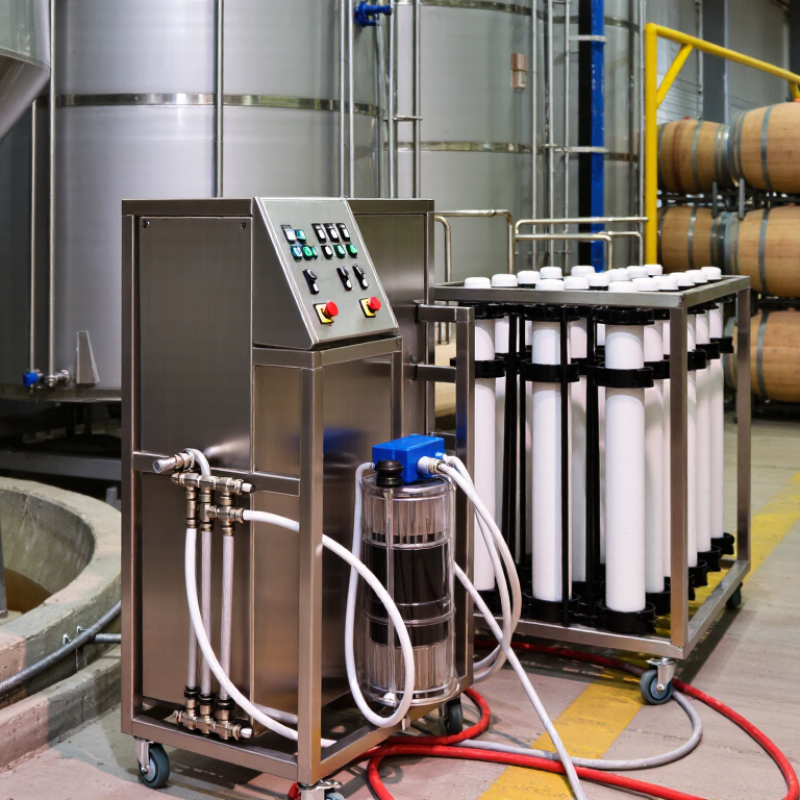
| Crossflow Membrane Filtration System | Continuously separates suspended solids and microorganisms while reducing disposable filter-media use. | Wine polishing, clarification of difficult lots, and recovery of product from lees or cloudy streams. | Sanitary 316L product-contact surfaces, low-dead-leg piping, membrane modules, automated cleaning circuits, pressure monitoring, and reliable flow control. | Flux and retention depend on membrane type, transmembrane pressure, crossflow velocity, temperature, viscosity, and fouling load. Process trials are needed before scale-up. | Perform a prompt rinse, validated alkaline wash, acid cleaning when compatible, final rinse, and sanitation. Verify cleaning endpoint by conductivity, pH, or other documented criteria. | Track normalized permeate flow, pressure, temperature, pump performance, membrane integrity, valve function, and cleaning chemical concentration. | High pressure, rotating pumps, chemical exposure, hot cleaning solutions, and membrane rupture are possible hazards. Use relief devices, guarding, PPE, and written operating limits. | Membrane polymers, seals, lubricants, and cleaning chemicals must be suitable for food contact and the intended wine process. Wastewater discharge and chemical storage rules may apply. |
| Depth Filter Module | Captures particles throughout a porous filter structure and is used for clarification or pre-filtration. | Wine polishing, pre-filtration before membrane treatment, and protection of bottling equipment. | Food-contact filter media, sanitary housing, secure seals, low-drainage design, and materials compatible with wine acidity and cleaning conditions. | Capacity is influenced by turbidity, filter depth, flow rate, viscosity, and differential pressure. Select the grade using measured turbidity and trial data. | Most disposable modules are replaced rather than chemically regenerated. Clean and sanitize reusable housings, drain fully, and prevent microbial growth during storage. | Inspect housing seals, clamps, vents, drains, pressure gauges, and module seating. Record filter lot, installation time, flow, pressure, and replacement reason. | Pressure release, wet floors, incorrect installation, and contaminated disposable media are the main concerns. Depressurize before opening and handle used media hygienically. | Filter media and housing components should have destination-market food-contact documentation. Disposal must follow local waste rules, particularly when wine residues or chemicals are present. |
| Turbidity Meter and Inline Monitoring System | Measures clarification performance and helps determine filter changeover or process endpoint. | Tank transfer, filtration control, bottling-line monitoring, and quality verification. | Use sanitary sample points or inline fittings, cleanable optical windows, compatible seals, and a design that minimizes stagnant liquid. | Readings are affected by bubbles, color, particle size, temperature, calibration standard, and installation geometry. Use consistent sampling and measurement procedures. | Rinse the sensor after use, clean optical surfaces with compatible solutions, sanitize without damaging the probe, and prevent dried wine deposits. | Perform routine calibration or verification with suitable standards, inspect cables and seals, and document deviations and corrective actions. | Electrical hazards, pressurized sample lines, hot liquid, and chemical exposure may occur. Use rated instruments, safe sample valves, and electrical protection in wet areas. | Measurement records should support traceability and quality-system requirements. Electrical, electromagnetic compatibility, and food-contact requirements depend on installation and market. |

 '
'
