Best Arc Floor Lamps Manufacturers in China?

Choosing among the Best Arc Floor Lamps Manufacturers in China requires more than comparing catalog photos. Buyers should examine frame stability, finish consistency, wiring quality, dimmer compatibility, and packaging protection. A tall curved lamp can look elegant in a showroom, yet wobble beside a sofa if its base is undersized. Small details matter.

The market context is substantial, though arc lamps are rarely measured separately. Grand View Research valued the global lighting market at USD 124.7 billion in 2023 and projected a 5.7% compound annual growth rate from 2024 to 2030. This figure covers lighting broadly; it should not be mistaken for Arc Floor Lamps sales. It does, however, show why manufacturers compete on design, energy performance, and reliable production. Dieter Rams, an influential industrial designer, offered a useful design principle: “Good design is as little design as possible.” For an arc lamp, that means a clean silhouette must still conceal dependable joints and safe, well-finished wiring.

China offers a wide supplier base, but a polished product page is not proof of factory capability. Ask for material specifications, close-up finish photos, sample lead times, and inspection records. Check whether the supplier builds the lamp in-house or coordinates outside workshops. Then compare the same details across samples. A little friction here is useful. Supplier claims can sound convincing, and a single sample may not reveal batch variation. A careful shortlist should balance visual quality, documented quality control, communication, and realistic delivery terms.
Best Arc Floor Lamps Manufacturers in China?

Arc Floor Lamps: Structure, Types, and Common Applications

Arc Floor Lamps: Structure, Types, and Common Applications

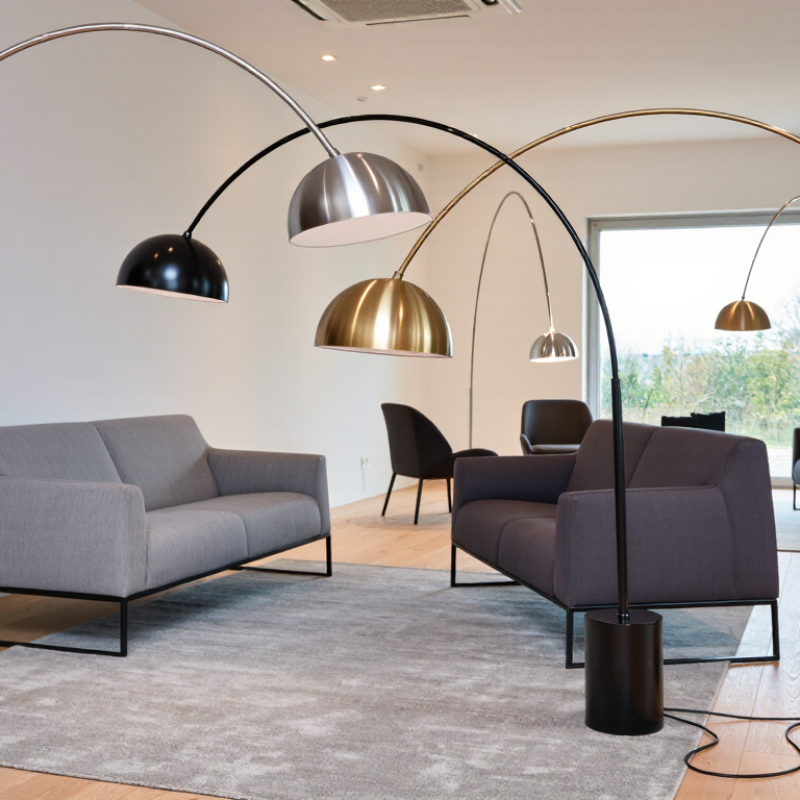
An arc floor lamp usually has a weighted base, an upright stem, a curved arm, and a shade. The arm reaches over furniture without needing a ceiling fixture. Its balance matters: a long reach paired with a light base can wobble when nudged. Check the joints, too. They should hold the shade steady while allowing practical adjustment. A well-routed cord keeps the floor area tidy.

Common designs include fixed single-arc lamps, adjustable models, and multi-arm versions that spread light across a wider area. Shades may direct light downward for reading or diffuse it for softer room lighting. Metal arms offer a slim profile, while fabric or glass shades change the feel of the light. Small details matter. A shade that looks elegant in a photo may feel too bulky beside a compact sofa.

These lamps suit living rooms, reading corners, and dining areas where overhead wiring is inconvenient. Position the base outside walking paths, then check that the shade clears the ceiling and nearby furniture. When assessing manufacturers in China, ask for arm dimensions, base weight, material specifications, and finish samples. A product sheet helps, but seeing the lamp assembled can reveal balance issues that measurements miss. Even then, room proportions are easy to misjudge.

China’s Arc Floor Lamp Manufacturing Landscape

Best Arc Floor Lamps Manufacturers in China?
China’s Arc Floor Lamp Manufacturing Landscape

China’s arc floor lamp manufacturing landscape combines metalworking, electrical assembly, finishing, and packaging. Production capabilities vary between factories. Some focus on custom designs, while others prioritize repeatable models and larger orders. Common components include steel or aluminum frames, weighted bases, fabric shades, and adjustable joints. Guangdong and Zhejiang have broad lighting supply networks, though individual factory capabilities still need checking. A dense supply chain can help with sourcing. It does not guarantee consistent quality.

For buyers, the key differences often appear in details: a stable base, smooth arm movement, clean welds, and a cord that sits neatly along the frame. Ask how the factory checks balance and joint durability. Request current production photos and a sample before approving specifications. Confirm dimensions, finish, packaging, and electrical requirements in writing. Small mismatches matter. A polished sample may not fully represent routine production, so inspection plans deserve attention. Factory descriptions can sound tidier than the manufacturing process itself.

Tips: Measure the lamp’s reach and base footprint against the intended room. Test the sample on uneven flooring. Check shade alignment and packaging protection. Keep approved specifications in a dated document; memory is unreliable.

China’s Arc Floor Lamp Manufacturing Landscape

Typical listed dimensions for consumer arc floor lamps (cm). These reference ranges describe common product specifications, not China-wide production averages; actual dimensions vary by design and supplier.

How Arc Floor Lamps Are Designed and Produced

Arc Floor Lamps: How They Are Designed and Produced

Arc floor lamps begin with a practical challenge: the shade must reach a chair or table without blocking movement. Designers map the base, curved arm, and shade position in a full-scale drawing. They check balance, height, and cord routing before selecting materials. A broad, weighted base helps resist tipping, while a steel or aluminum arm provides support. Small adjustments matter. A few centimeters can change where the light lands.

During production, metal tubes are cut, bent, and joined, then given a specified surface finish. Workers fit the stem, arm, socket, and shade, checking joints for looseness and visible gaps. Electrical components are assembled and tested according to the manufacturer’s quality procedures. The completed lamp is checked for wobble and possible packaging damage. A polished sample can still hide a weak joint. Repeated inspections are less glamorous, but useful.

Tips: Ask for a dimensioned drawing, material details, and photos of the lamp beside furniture. Confirm the base weight, shade angle, cord length, and bulb compatibility. Request a sample if finish or balance is critical. Drawings cannot predict every room, so leave space for adjustment. This detail is easy to miss.

Best Arc Floor Lamps Manufacturers in China? – How Arc Floor Lamps Are Designed and Produced

This table outlines common design and production stages for arc floor lamps. Materials, construction methods, dimensions, and inspection procedures vary by model and manufacturer; it is not a ranking of individual factories.

Stage Design or Production Activity Common Materials and Components Practical Checks and Outputs
1. Product brief and layout Define the intended use, shade position, lamp reach, overall height, finish, and lighting type. The curved arm is planned to place the light over a seating or reading area. Product requirements, reference drawings, proposed base, arm, shade, and light source. Confirm the proposed footprint and reach suit the intended space; identify the target market and applicable electrical-safety requirements.
2. Structural design Develop the base, upright support, curved arm, joints, and shade connection. The design must balance the extended arm while allowing the lamp to stand securely. Common options include steel tubing or other metal sections, a weighted metal base, fasteners, and protective foot pads. Review stability, joint strength, assembly access, and the position of the centre of gravity. Structural details depend on the lamp's dimensions and materials.
3. Lighting and electrical design Select an integrated LED light source or a replaceable lamp holder and bulb. Plan the switch, wiring route, strain relief, and connection to the power supply. LED module or lamp holder, insulated wiring, switch, plug, and, where required, an LED driver. Check that electrical components are compatible with the specified voltage, power, dimming method, and destination-market requirements.
4. Prototyping and design review Make a sample or prototype to assess the arc shape, shade orientation, assembly sequence, appearance, and stability before production tooling or batch manufacture. Prototype metal parts, sample finish, shade, electrical components, and assembly hardware. Review fit, alignment, reach, switch access, light direction, and stability. Revise drawings or components when the sample does not meet the agreed specification.
5. Metal-part fabrication Cut and form the base and arm components. Depending on the design, metal tubing may be bent, and parts may be drilled, welded, or mechanically joined. Steel or other specified metals; joining hardware; optional internal cable-routing components. Inspect part dimensions, bend consistency, joint position, surface condition, and alignment against approved drawings or samples.
6. Surface finishing and shade production Prepare and finish exposed metal parts. Shade production depends on the design and may involve formed metal, fabric, glass, or other suitable materials. Powder-coated or plated metal finishes are common options; shade materials and coatings vary by product. Check finish coverage, colour consistency, visible defects, shade fit, and the condition of edges and attachment points.
7. Assembly and in-process inspection Install wiring and electrical components, connect the arm and shade, fit the base, and assemble the lamp according to the product instructions. Wiring, switch, plug, light source, fasteners, base, curved arm, shade, and protective pads. Verify correct component installation, secure fasteners, cable routing, arm alignment, and that the lamp can be assembled consistently.
8. Final inspection and testing Inspect the completed lamp and perform electrical and functional checks appropriate to the product and intended sales market. Finished lamp, approved electrical components, and the relevant test and inspection procedures. Typical checks can include operation of the switch and light source, visual inspection, stability, and applicable electrical-safety tests. The required tests depend on the product design and destination market.
9. Packing and shipment preparation Disassemble or secure parts as needed, protect finishes and fragile components, and pack the lamp to reduce movement and damage during transport. Protective wrapping, formed inserts or other cushioning, carton, and assembly instructions. Check that components are protected, accessories and instructions are included, and the packed product meets the agreed shipping and handling requirements.

Criteria for Evaluating Chinese Arc Floor Lamp Manufacturers

When evaluating Chinese arc floor lamp manufacturers, look beyond catalog photos. An attractive curve means little if the base shifts under the extended arm. Ask for the lamp’s dimensions, weight, material specifications, and stability test results. Check how the shade, joints, and base are finished. Small scratches around a welded seam can reveal more than a showroom display. Details matter.

Request a sample and inspect it under ordinary room conditions. Does the arm stay in position? Is the cable protected where it enters the frame? Does the lamp feel balanced on wood or tile? Ask how the manufacturer controls quality across production batches, not only on a hand-selected sample. Clear inspection records and traceable specifications make comparisons easier. A polished sample can still mislead.

Communication is another practical test. Share a drawing or a simple change request, then see whether the factory confirms measurements, tolerances, and timing in writing. Ask about packaging tests, replacement parts, and production lead times before placing an order. These answers help reveal whether the supplier can support repeat orders. No checklist is perfect. I would still leave room for a second sample, especially when the finish or arm geometry changes.

Leading Arc Floor Lamp Manufacturers in China and Their Capabilities

Best Arc Floor Lamps Manufacturers in China?

Leading arc floor lamp manufacturers in China may offer more than assembly capacity. Strong suppliers can support metal forming, welding, surface finishing, wiring, and final inspection under one production system. Ask how they control the curve of the arm: small differences can shift the shade several centimeters and affect balance.

Details matter. A stable base, smooth height adjustment, and protected cable routing are practical signs of careful engineering.

Manufacturers with in-house design teams can adapt arm reach, shade size, finishes, and plug specifications to a project brief. Their engineers should explain material choices and provide clear drawings before sampling. Request a working sample, then check its stability on carpet and hard flooring. Test the switch, inspect welds, and leave the lamp on long enough to notice heat or flicker. Production capacity matters, but repeatability matters more. A polished sample can hide uneven finishing in a larger batch; this is easy to overlook. Buyers should also confirm packaging tests, inspection records, and lead times in writing. Some factories communicate these details well; others need patient follow-up.

'