
Top Bourbon Filtration Systems for Global Buyers
For global buyers, bourbon filtration is not a simple equipment purchase. It is a quality decision that affects aroma, color, texture, yield, and product consistency. A clear spirit may look impressive, yet excessive filtration can remove valuable flavor compounds. The best system depends on bourbon style, production volume, proof, temperature, and packaging plans.
Whiskey consultant Nancy Fraley captures the practical concern: “Filtration should protect flavor, not erase it.” Her view reflects an important industry lesson. A system that works well for a small craft distillery may fail in a high-volume facility. Plate-and-frame filters can support controlled clarification. Depth filters may handle suspended particles efficiently. Membrane systems offer tighter separation, but they require careful pressure control and maintenance. Activated carbon may be useful in limited applications, though it can soften character too aggressively.
Global buyers should examine food-contact materials, sanitary design, filter ratings, replacement availability, and technical support. Documentation matters. So do cleaning procedures, operator training, and batch traceability. Regional standards can differ, so buyers should confirm applicable food-safety and alcohol-production requirements before installation. No system is perfect. Even experienced teams can misjudge filtration speed or flavor loss.
This guide compares leading bourbon filtration systems through practical criteria. It considers performance, operating cost, scalability, cleaning demands, and supplier reliability. Real-world conditions matter more than attractive specifications. A small pilot trial is often wiser than an immediate full-scale purchase. The result should be bourbon that remains clean, expressive, and consistent from barrel to bottle.
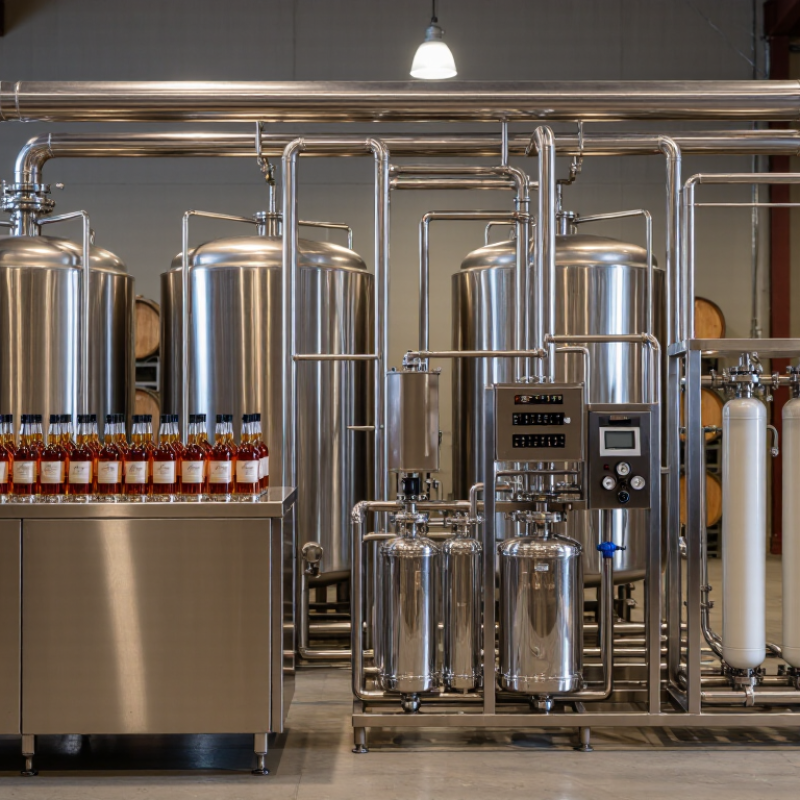
Define Bourbon Specs: 51% Corn, New Charred Oak, and 40% ABV Minimum
Top Bourbon Filtration Systems for Global Buyers
Bourbon specifications should guide every filtration decision. The mash must contain at least 51% corn. It must mature in new charred oak containers. At bottling, bourbon requires a minimum strength of 40% ABV. Filtration cannot correct an incorrect mash bill, aging vessel, or final alcohol level. It only refines the liquid after production.
For global buyers, depth filtration can remove visible particles while preserving aroma and barrel character. Membrane systems offer tighter control, but excessive filtration may reduce texture. Chill filtration can improve clarity during cold storage, yet it may also remove desirable fatty compounds. I have seen clear bourbon lose some warmth on the palate. Clear is not always better. Equipment should use food-grade materials, stable pressure, and easy-to-clean contact surfaces. Verify local import and labeling requirements before shipment.
Tips: Test a small batch first. Compare unfiltered, lightly filtered, and polished samples. Record color, aroma, sediment, flow rate, and ABV before and after treatment. A 40% ABV reading should be confirmed with calibrated instruments. Temperature affects measurements. That detail is easy to miss. Keep batch records, filter-change dates, and cleaning checks. Buyers should request technical documents, but documents alone are not proof. Taste panels and laboratory results can disagree, and that deserves a second review.
Top Bourbon Filtration Systems for Global Buyers - Define Bourbon Specs: 51% Corn, New Charred Oak, and 40% ABV Minimum
| Filtration System | Primary Function | Typical Rating or Operating Range | Strengths | Key Considerations for Bourbon |
|---|---|---|---|---|
| Depth Filter Sheets | Removes suspended solids, barrel particles, and visible haze through a porous depth medium. | Common nominal clarification grades range from approximately 1 to 20 micrometres, depending on the filter medium. | Simple operation, relatively low capital cost, and suitable for batch production. | Choose a food-contact-certified medium and validate extractables, flavor impact, and product loss. |
| Plate-and-Frame Filter | Uses filter sheets or filter pads for batch clarification before bottling. | Operating pressure is commonly controlled within the equipment supplier’s rated range; many beverage units are designed for low-to-moderate pressure service. | Flexible batch capacity and easy grade changes for different clarification targets. | Monitor differential pressure and avoid excessive filtration that could remove desirable color or aroma compounds. |
| Cartridge Depth Filter | Provides enclosed clarification with replaceable depth-media cartridges. | Typical beverage clarification cartridges are available in nominal ratings of about 1 to 10 micrometres. | Compact footprint, reduced operator exposure, and consistent installation. | Confirm compatibility with ethanol, barrel-derived compounds, cleaning chemicals, and the intended production temperature. |
| Membrane Microfiltration | Reduces fine particulates and can improve visual clarity using a defined membrane separation process. | Microfiltration commonly uses membrane pores below approximately 1 micrometre, with exact ratings depending on the membrane design. | High and repeatable clarification performance when correctly sized and operated. | Requires careful flux, pressure, and fouling control; pilot testing is recommended for high-proof spirits. |
| Chill-Filtration System | Cools the spirit to encourage precipitation of fatty acid esters and related haze-forming compounds, followed by filtration. | The selected temperature depends on the spirit’s composition, proof, and desired appearance; it must be established through product trials rather than a universal set point. | Can improve clarity at lower serving temperatures. | May reduce some congeners and mouthfeel components; use only when the target sensory profile supports it. |
| Activated-Carbon Treatment | Adsorbs selected organic compounds and can reduce certain off-notes or color components. | Performance depends on carbon type, contact time, flow rate, and spirit composition rather than a single pore-size rating. | Useful for specific corrective-treatment applications. | Not normally a first-choice polishing step for character-rich bourbon because it may remove desirable aroma, flavor, and color. |
| Final Sterile-Grade Polishing Filter | Provides final fine particulate control immediately before filling. | Fine membrane ratings may be selected around 0.45 micrometres or lower when the process and validation justify that level. | Enclosed final-stage protection and improved filling-line cleanliness. | Validate throughput, alcohol compatibility, integrity testing, and flavor retention; filtration does not replace sanitary bottling controls. |
Bourbon Specification Reference for Global Buyers
| Specification | Minimum or Maximum Requirement | Why It Matters When Selecting Filtration Equipment |
|---|---|---|
| Corn Content in the Mash Bill | At least 51% corn. | Filtration cannot correct an unsuitable mash bill; ingredient and production records must establish bourbon eligibility before filtration is considered. |
| Distillation Strength | Distilled to no more than 160 proof, equivalent to 80% ABV. | Equipment materials, seals, and filter media should be suitable for the intended ethanol concentration. |
| Barrel Entry Strength | Entered into new charred oak containers at no more than 125 proof, equivalent to 62.5% ABV. | Filtration equipment should be selected for the actual strength handled during processing, not only the final bottling strength. |
| Oak Requirement | Aged in new, charred oak containers. | The filtration process should preserve the intended color, aroma, and flavor compounds extracted from the new charred oak. |
| Bottling Strength | At least 80 proof, equivalent to 40% ABV. | Proof should be checked after filtration and dilution because water addition, temperature, and process losses can affect the final result. |
| Filtration Compliance | No filtration method can replace the legal requirements for bourbon production, aging, labeling, or bottling. | Use food-contact materials, documented cleaning procedures, traceable batch records, and proof and sensory checks before release. |
Note: Filtration ratings and operating ranges are general engineering reference values. Final selection should be confirmed through pilot trials, compatibility testing, sensory evaluation, and applicable local regulations.
 '
'
