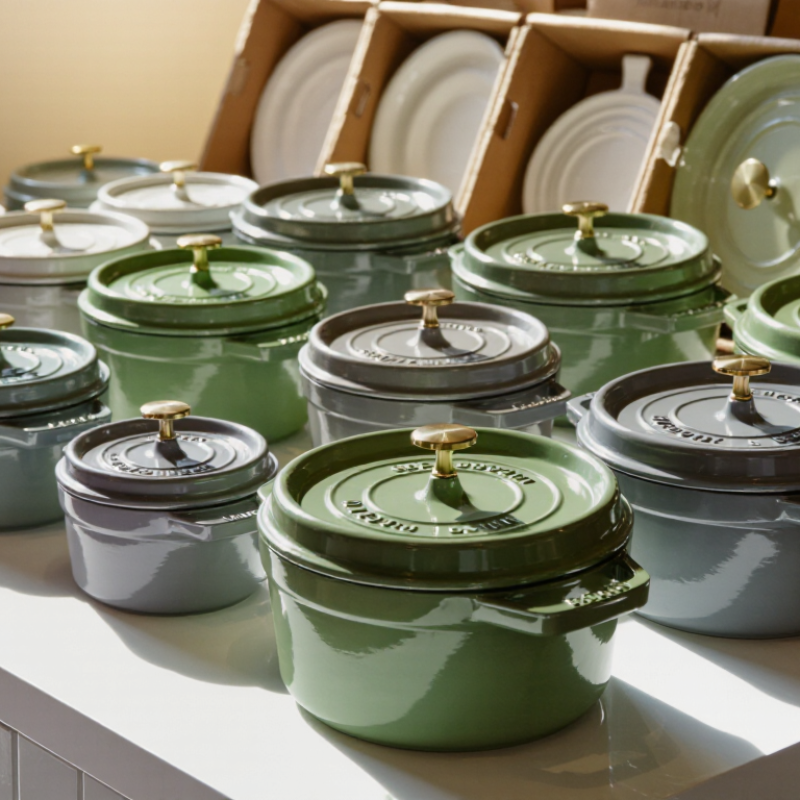
10 Best Covered Casserole Pans for Wholesale Buyers?

Choosing cookware for wholesale distribution requires more than attractive product photos and a low unit price. This guide reviews the 10 Best Covered Casserole Pans for Wholesale Buyers through practical purchasing criteria. Each Covered Casserole Pan is considered for material quality, heat performance, lid fit, capacity, packaging, and supply consistency. A pan may look impressive on a showroom shelf. However, its handles, weight, and finish determine whether customers enjoy using it repeatedly.

Details matter. Wholesale buyers should inspect sample units before placing large orders. Check whether the lid seals securely without rattling during transport. Examine the cooking surface for even finishing, smooth edges, and easy cleaning. Confirm carton strength, labeling accuracy, minimum order quantities, and replacement support with suppliers. These details can influence returns and long-term retailer trust. Not every pan wins.

The selections suit different commercial needs, including family-sized meals, restaurant preparation, gift sets, and everyday home cooking. Some models prioritize durability, while others offer lighter handling or stronger visual appeal. We also consider whether the quoted value remains reasonable after freight, protective packaging, and storage costs. That calculation is easy to overlook. Product claims should be verified through specifications, samples, and supplier documentation rather than assumptions. This introduction is not a promise of universal performance; cooking habits, stovetop compatibility, and market preferences vary. Still, the comparison offers a clear starting point for buyers seeking dependable cookware, sensible margins, and fewer surprises after shipment.

10 Best Covered Casserole Pans for Wholesale Buyers?

What Is a Covered Casserole Pan and Why Does It Matter?

A covered casserole pan is a deep cooking vessel with a fitted lid. It is designed for baking, braising, reheating, and serving food while retaining moisture. The cover slows evaporation and helps maintain an even texture. This matters when buyers supply restaurants, caterers, hotels, or institutional kitchens.

The lid also affects transport, storage, and food safety. The FDA Food Code 2022 sets 135°F (57°C) as the minimum hot-holding temperature for cooked food. It also sets 41°F (5°C) for cold holding. A secure lid can reduce spills and exposure during these transitions. However, it cannot replace temperature control. A lid is not magic.

Wholesale buyers should inspect lid fit, handle strength, wall thickness, and stacking stability. Test samples through repeated heating and cooling cycles. Small warping can create leaks. That detail is easy to miss. The U.S. Department of Agriculture advises refrigerating perishable food within two hours, making quick cooling and safe storage essential. Grand View Research estimated the global cookware market at roughly US$19 billion in 2023, showing strong commercial demand for durable cookware. Yet market growth does not guarantee product quality. Buyers should compare heat distribution, cleaning performance, packaging protection, and replacement availability before placing large orders. A lower unit price may become expensive after damaged lids, returns, or inconsistent cooking results.

10 Best Covered Casserole Pans for Wholesale Buyers: Typical Capacity Comparison

Covered casserole pans are oven-safe baking or serving dishes supplied with matching lids. Capacity is an important wholesale consideration because it affects portion size, storage efficiency, shipping weight, and the types of meals the pan can accommodate. The chart compares common casserole capacities from 1.5 to 5 quarts; actual dimensions and usable capacity vary by shape and manufacturer.

Key Materials, Shapes, Sizes, and Lid Designs to Compare

For wholesale buyers, material selection affects heat control, durability, weight, and landed cost. Stainless steel resists rust and handles repeated commercial use. Aluminized steel heats quickly and often reduces unit weight. Ceramic offers attractive table presentation, but it needs careful packing. Cast iron retains heat well, yet shipping becomes expensive. I have seen buyers focus on price and overlook handling damage. That mistake can erase the original savings.

Shape should match the food and storage plan. Rectangular pans suit lasagna, roasted vegetables, and larger production batches. Square pans fit tighter shelves and display counters. Round pans work well for pies and shared dishes. Common wholesale sizes include 1.5-quart, 2.5-quart, 4-quart, and family-size formats. Check interior depth, not only the outside measurement. A deeper pan may prevent spills, but it can slow serving and increase material use. Nesting efficiency also matters during warehouse storage.

Lid design deserves practical testing. A flat lid saves shelf space, while a domed lid protects toppings and bulky foods. Clear glass supports quick product checks. Opaque metal hides stains and may survive rougher handling. Steam vents can reduce condensation, but loose vents may disappear during washing. Handles should stay cool enough for safer movement. Tight lids help delivery, though they can trap moisture. Do not assume one design suits every buyer. Test samples with hot food, stacked cartons, and repeated washing before placing a large order.

How to Evaluate the 10 Best Covered Casserole Pans

How to Evaluate the 10 Best Covered Casserole Pans

Wholesale buyers should evaluate covered casserole pans through repeated-use performance, not appearance alone. In my purchasing experience, the strongest options balance material strength, heat distribution, weight, and cost. A thick base should warm evenly without creating a dark spot under the center. Check whether the lid sits firmly, releases steam safely, and remains stable when the pan is moved.

Measure practical details. A 3.5-liter pan may suit family meals, while larger kitchens may need 5 liters or more. Handles should stay comfortable with oven gloves and provide a secure grip. Inspect rivets, rims, and interior coatings under bright light. Tiny surface flaws can become cleaning problems after wholesale customers use the pan daily. Compatibility with gas, electric, ceramic, and induction cooktops also affects resale value.

Packaging deserves equal attention. A well-made pan can still arrive with a chipped lid or bent handle. Request drop-test information, carton dimensions, stackability, and replacement-part support. Ask for sample testing before placing a large order. My own early mistake was judging only the pan’s weight; heavier did not always mean better cooking. Some lids trapped too much moisture, while others lost heat around the rim. Buyers should record cooking results, return rates, and customer feedback before final approval. Ten attractive samples may not represent ten reliable wholesale choices.

Wholesale Buying Criteria: Quality, Pricing, and Order Volume

For wholesale buyers, quality starts with repeatable performance, not a polished sample. Grand View Research valued the global cookware market at about USD 19.5 billion in 2023, with continued growth expected through 2030. That growth increases supplier options, but also increases quality variation. Check wall thickness, lid alignment, handle strength, and coating consistency across several production samples. A covered casserole pan should retain heat evenly and resist warping after repeated heating and cooling. Test it in real kitchens. A beautiful sample can hide batch problems.

Pricing must include landed cost, not only the factory quotation. Request separate figures for the pan, lid, packaging, tooling, inspection, freight, and import handling. Packaging deserves attention. A cracked glass lid can erase the profit from an entire carton. The 2024 Packaging Machinery Manufacturers Institute report highlights rising packaging efficiency pressures, which makes compact, protective packaging commercially important. Compare at least three quotations using identical specifications. Cheap is not always efficient.

Order volume should match sales evidence and storage capacity. A low MOQ may reduce inventory risk, but it can raise unit pricing. A large MOQ may unlock better pricing while creating cash-flow pressure. Keep a pilot order before committing to full production. Review defect rates, carton damage, and customer feedback. I would also negotiate replacement terms in writing. That step is often overlooked. Even experienced buyers sometimes trust optimistic forecasts too much. Use historical sell-through data, seasonal demand, and a modest safety margin when setting the final quantity.

Care, Safety, Packaging, and Supplier Verification Considerations

10 Best Covered Casserole Pans for Wholesale Buyers?

Wholesale buyers should inspect care instructions before comparing prices. The FDA Food Code 2022 requires food-contact surfaces to be smooth, durable, corrosion-resistant, and easy to clean. Pans should tolerate repeated washing without peeling or exposing base metal. Check whether lids resist warping near 135°F, the FDA hot-holding reference temperature. Do not assume every “oven-safe” label covers the lid, handle, or sudden temperature changes. That assumption causes avoidable returns.

Safety also depends on clear supplier evidence. Request material specifications, coating test results, maximum temperatures, and food-contact compliance documents. The FDA Food Code is guidance, not automatic product certification. Ask for current, lot-linked reports instead of generic certificates. One weak point remains. Documents can be outdated, incomplete, or copied. A small sample audit is wiser than trusting a polished sales sheet.

Packaging deserves equal attention. ISTA 3A testing evaluates parcel risks, including drops, vibration, and compression. Ask suppliers to provide test conditions and damage rates from pilot shipments. The U.S. Environmental Protection Agency’s 2024 national strategy targets a 50% reduction in food loss and waste by 2030. Durable pans, replaceable lids, and right-sized cartons can support that goal. Use molded separators, corner protection, and moisture-resistant cartons. Photograph pre-shipment packing. It seems minor, but it makes disputes easier to verify. Care labels should state handwashing limits, stacking rules, and thermal-shock warnings in plain English.

10 Best Covered Casserole Pans for Wholesale Buyers? - Care, Safety, Packaging, and Supplier Verification Considerations
Rank Pan Type Typical Size and Capacity Construction and Cooking Performance Cover Design Typical Temperature Guidance Care and Safety Requirements Wholesale Packaging Approach Supplier Verification Checks Best Wholesale Fit
1 Enameled Cast-Iron Casserole 3.5–5.5 qt
26–30 cm diameter
Approx. 5–8 kg per unit
Thick cast iron provides strong heat retention and even simmering. Porcelain enamel creates a non-reactive cooking surface and supports presentation from oven to table. Matching enameled cast-iron lid with stainless-steel or heat-resistant knob. Check lid seating and steam-release design. Pan commonly rated up to approximately 240–260°C; lid, knob, and manufacturer instructions may have lower limits. Hand lifting is recommended because of high weight. Avoid thermal shock, abrasive cleaners, and metal impact. Inspect enamel for chips before sale. Individual molded-pulp or high-density foam protection; reinforced five-layer corrugated carton; edge and lid separation recommended. Verify food-contact enamel documentation, heavy-metal migration testing, coating adhesion, thermal-shock testing, drop-test records, and batch traceability. Premium cookware, gift sets, slow cooking, and oven-to-table retail programs.
2 Tri-Ply Stainless-Steel Casserole 2.5–5 qt
20–28 cm diameter
Approx. 1.5–3 kg per unit
Stainless-steel cooking surfaces with an aluminum core offer durability, corrosion resistance, and more even heating than single-layer steel. Vented stainless-steel or tempered-glass lid. Glass lids should include a secure rim and heat-resistant handle. Uncoated stainless-steel pans are often suitable for high oven temperatures; glass lids and handles usually require a lower verified limit. Dishwasher compatibility depends on finish and handle construction. Avoid prolonged salt or acidic soaking; dry thoroughly to reduce spotting. Protective sleeve, lid separator, recycled paperboard inserts, and carton dividers. Use corrosion-resistant packaging for humid shipping routes. Verify stainless-steel grade, thickness, weld quality, handle pull strength, lid fit, food-contact declarations, and salt-spray or corrosion test data. High-volume everyday cookware and professional-style kitchen ranges.
3 Hard-Anodized Aluminum Casserole 3–5 qt
24–28 cm diameter
Approx. 1.5–2.5 kg per unit
Hard-anodized aluminum is lightweight, distributes heat efficiently, and is generally more resistant to scratching than untreated aluminum. Tempered-glass lid with metal rim or silicone edge. Confirm whether the lid is oven-safe separately from the pan body. Typical pan guidance is about 200–260°C, depending on handles and coating. Glass and silicone components commonly reduce the limit. Use non-abrasive tools and cleaners. Do not assume dishwasher safety unless documented. Check for coating wear, exposed aluminum, or loose handles. Use individual polybag or paper wrap, full-surface separators, corner protection, and a carton designed to prevent handle-to-handle contact. Verify anodizing uniformity, coating thickness where applicable, abrasion resistance, handle torque, migration testing, and documented temperature limits. Lightweight retail lines, apartment kitchens, hospitality supply, and value-conscious buyers.
4 Stainless-Steel Induction Casserole 2–4 qt
18–24 cm diameter
Approx. 1–2.5 kg per unit
Magnetic stainless-steel base or encapsulated disk supports induction compatibility while retaining conventional stovetop and oven versatility. Fitted stainless-steel or tempered-glass lid with a heat-resistant knob and controlled steam vent. Verify separate pan, lid, and handle limits. Induction bases should be checked for flatness after thermal cycling. Use low-to-medium heat for delicate foods and avoid sliding the pan across glass cooktops. Stainless surfaces may show discoloration without affecting function. Use base protectors, lid clips or separators, moisture-resistant cartons, and clear induction-compatibility labeling on the inner pack. Verify induction heating test, base flatness, magnetic response, handle attachment, lid retention, food-contact compliance, and material composition. Modern kitchens, cookware assortments, induction-focused retailers, and export markets.
5 Forged Aluminum Nonstick Casserole 3–5 qt
24–28 cm diameter
Approx. 1.5–2.5 kg per unit
Forged aluminum gives a relatively light body with good heat response. A nonstick interior supports low-oil cooking and easier release. Tempered-glass lid with silicone or phenolic knob. Confirm whether the lid can be used in an oven. Many nonstick interiors are limited to approximately 180–230°C; the exact limit depends on coating, handle, and lid materials. Use wood, silicone, or approved plastic utensils. Avoid aerosol cooking sprays, overheating an empty pan, abrasive pads, and sudden cooling. Use scratch-resistant tissue, lid separators, molded pulp, and carton labels warning against stacking without protection. Request coating composition, PFAS-related claim substantiation where applicable, abrasion and release testing, migration reports, handle strength, and lot records. Large-volume consumer retail, starter cookware sets, and easy-clean product categories.
6 Ceramic-Coated Aluminum Casserole 2.5–4.5 qt
22–28 cm diameter
Approx. 1.3–2.3 kg per unit
Aluminum body offers fast heating, while a ceramic-based sol-gel coating provides a smooth cooking surface without traditional PTFE chemistry. Glass lid with silicone rim or coated metal lid. Check seal quality, knob temperature rating, and vent performance. Common guidance ranges from approximately 200–230°C, but coating and lid limits must be confirmed for each model. Use moderate heat and soft utensils. Avoid thermal shock, aggressive detergents, and prolonged empty heating. Coating life varies with use and cleaning. Separate the lid from the pan with soft paperboard or molded pulp; use anti-scuff sleeves and moisture-resistant outer cartons. Verify coating formulation, lead and cadmium migration results, abrasion cycles, thermal cycling, nonstick performance, and claim documentation. Design-led retail ranges and buyers seeking a lightweight alternative to cast iron.
7 Carbon-Steel Covered Casserole 3–5 qt
24–28 cm diameter
Approx. 2–4 kg per unit
Carbon steel heats quickly, tolerates high temperatures, and can develop a seasoned surface when properly maintained. Steel lid or high-temperature coated lid. A close-fitting lid is useful for braising but should not be treated as pressure cookware. Pan bodies can tolerate high oven temperatures; coating, seasoning, handles, and lid materials may impose lower limits. Dry immediately after washing, apply a light oil film, and avoid long acidic cooking until seasoning is established. Surface rust requires cleaning and re-seasoning. Use oil-resistant paper, vapor-inhibiting packaging where appropriate, desiccant for controlled shipments, and separators to prevent edge damage. Verify steel thickness, coating or pre-seasoning process, corrosion testing, oil migration where relevant, lid fit, and humidity-shipping performance. Outdoor cooking, specialty kitchenware, restaurant supply, and durable-use product lines.
8 Oven-Safe Borosilicate Glass Casserole 2–4 qt
20–28 cm length or diameter
Approx. 1–2.5 kg per unit
Transparent glass allows food visibility and is non-reactive. Borosilicate glass generally has better thermal-shock resistance than ordinary soda-lime glass. Matching glass cover or vented glass lid. Cover should have a stable grip and sufficient clearance for steam release. Temperature limits vary significantly. Never assume freezer-to-oven or stovetop suitability without written instructions for the exact glass formulation. Avoid direct flame, hot-to-cold shock, chipped edges, and placing hot glass on wet or cold surfaces. Inspect every unit for cracks and bubbles. Use molded pulp or die-cut corrugated inserts on all sides; individually box units and perform vibration and drop testing before mass shipment. Verify glass composition, thermal-shock testing, edge-strength testing, lid fit, food-contact compliance, warning labels, and packaging test results. Baking, meal preparation, transparent servingware, and kitchen-storage assortments.
9 Stainless-Steel Hotel-Style Pan with Cover 1/2 or 1/3 gastronorm format
Approx. 2.5–6 qt
Depth commonly 65–100 mm
Commercial stainless-steel construction supports batch cooking, buffet service, food holding, and repeated cleaning. Flat stainless-steel cover, hinged cover, or slotted serving cover. Confirm compatibility with the selected pan depth and format. Suitable temperature range depends on thickness, handles, and cover style. Verify hot-holding and oven-use instructions separately. Inspect corners, rolled edges, welds, and handles. Avoid sharp burrs and confirm that cleaning chemicals are compatible with the steel grade. Stack with protective separators, corner guards, and reinforced master cartons. Use carton labels showing dimensions, quantity, and nesting direction. Verify dimensional tolerances, stacking fit, steel grade, weld integrity, edge safety, dishwasher-cycle testing, and food-contact documentation. Restaurants, catering operations, institutional kitchens, buffets, and food-service distributors.
10 Enamel-Coated Steel Casserole 2–4 qt
20–26 cm diameter
Approx. 1–2 kg per unit
Thin steel provides a lighter product, while vitreous enamel offers a non-reactive surface and traditional appearance. Matching enamel-coated steel lid or glass lid with a heat-resistant handle. Check fit after heating and cooling cycles. Often suitable for oven use within approximately 200–250°C, subject to the lid, knob, coating, and handle specification. Avoid dropping or striking enamel surfaces. Do not use chipped cookware for food preparation. Hand washing helps preserve decorative finishes. Use molded pulp end caps, paper interleaving, protective film on decorative surfaces, and strong cartons resistant to edge compression. Verify enamel adhesion, impact resistance, thermal cycling, lead and cadmium migration, color stability, edge finishing, and lot traceability. Affordable homeware, seasonal collections, decorative kitchen ranges, and promotional programs.
Wholesale purchasing note: Temperature limits, coating chemistry, food-contact compliance, dishwasher claims, induction compatibility, and packaging performance must be confirmed against the supplier’s current technical specification and independent test reports. Before placing a production order, request pre-production samples, inspect critical dimensions and surfaces, approve the packaging artwork, and complete a documented carton drop or transport simulation.
'