Card Game Print is the process of turning a card game concept into a durable, playable, and visually consistent physical product. It includes artwork preparation, file checks, paper selection, color management, printing, cutting, collation, packaging, and quality inspection. Every stage affects the player’s experience. A slightly misaligned border can reveal a card’s identity. Uneven coating can make shuffling frustrating. Small details matter.
James Ernest, a veteran game designer and founder of Cheapass Games, once stated, “A game is a set of interesting choices.” That idea also applies to Card Game Print. Designers choose card thickness, surface texture, corner radius, finish, and box construction. Printers then translate those choices into production specifications. A linen finish may improve grip, while a smooth coating can make colors appear brighter. Neither option is perfect. The right choice depends on play style, budget, climate, and expected print volume.
Reliable production begins with a controlled prepress workflow. Printers inspect bleed areas, color profiles, safe zones, and image resolution before manufacturing starts. Proof copies are valuable because digital screens cannot fully reproduce physical color or texture. A red symbol may look accurate onscreen but print darker than expected. That mistake can force costly revisions.
This article explains how Card Game Print works from files to finished decks. It also examines materials, printing methods, quality control, pricing, and common production risks. Some assumptions may need reconsideration. Cheap printing is not always economical, and premium materials cannot rescue weak design.
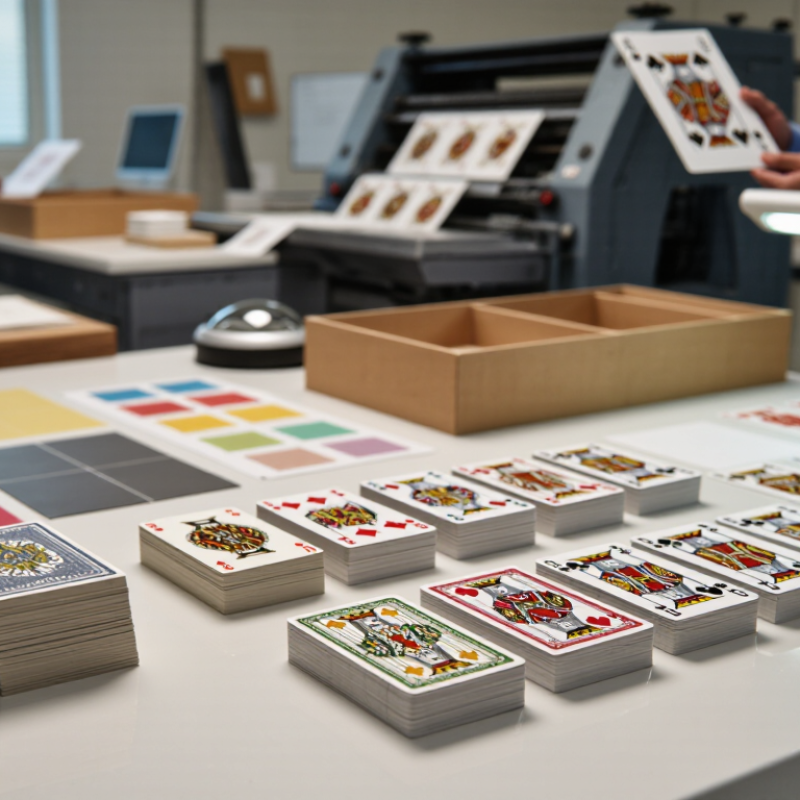
What Is Card Game Print and How Does It Work?
Card game printing turns a digital design into shuffled, playable cards. It includes prepress checks, color separation, paperboard selection, coating, cutting, and collation. Each stage affects how cards feel, shuffle, and survive repeated handling. The process begins with bleed lines, safe zones, and readable type. Files then move through proofing before full production. A small color shift can change a border, symbol, or visual hierarchy. Defects hide. The press behaves differently.
Why does this matter? According to ICv2’s 2023 market report, hobby game sales in the United States and Canada reached about 2.84 billion dollars. Grand View Research valued the global playing-card market at approximately 1.2 billion dollars in 2023. These figures show meaningful demand, but they also raise quality expectations. Poor registration can make a card look cheap. Weak coating may cause scratches after only a few sessions. Accurate collation matters even more, because one missing or repeated card can damage playability.
A professional print workflow uses calibrated color targets, measured cutting tolerances, and sample checks from different sheets. Card thickness must balance stiffness with easy shuffling. Gloss can improve contrast, while excessive shine may create glare under table lighting. A perfect digital proof can still mislead. Paper absorbs ink unevenly, and humidity changes its behavior. The best decisions often come from physical prototypes, not assumptions. There is no flawless specification; every choice trades cost, durability, appearance, or handling comfort.
Common card formats are produced by printing artwork on coated stock, adding a protective finish, and cutting sheets to precise dimensions.
Card dimensions determine the layout of the print file, the amount of artwork needed for bleed, and the cutting setup used after printing. Poker-size cards are approximately 63.5 × 88.9 mm, bridge-size cards are approximately 57.15 × 88.9 mm, tarot cards are commonly about 70 × 120 mm, and mini cards are commonly about 44 × 67 mm. Actual specifications can vary by printer and game design.
Measurements shown in millimeters; dimensions represent commonly used card formats.
Card game printing begins with the material beneath the artwork. Most playing cards use layered paperboard, often called card stock, because it balances stiffness, weight, and flexibility. A smooth surface helps fine lines remain sharp. A slightly textured surface can improve grip, but it may soften small details.
Printing inks add color and contrast. Reliable production usually uses process inks, while specialty inks can create metallic or fluorescent effects. After printing, a protective coating is applied. Gloss coatings make colors look brighter. Matte coatings reduce glare and feel softer. A clear varnish can also protect the surface from fingerprints and light scuffs. Some cards include a dark inner layer, which helps prevent light from passing through the card.
Tips: Ask for a physical proof before approving a large order. Check color, edge alignment, surface feel, and card thickness under normal lighting. Keep important text away from cutting lines. Small errors become obvious in a fan of cards. From practical testing, thicker stock is not always better; overly rigid cards may shuffle poorly. I once preferred a heavier finish, then noticed hand fatigue during longer games. That detail changed my material choice. Foil and specialty coatings can look impressive, but they may increase cost and require careful handling during production.
| Material or Component | Typical Specification | Primary Function | Key Performance Characteristics | Common Printing or Finishing Method | Important Production Considerations |
|---|---|---|---|---|---|
| Coated Playing-Card Paperboard | Approximately 280–350 g/m²; often supplied as a multi-ply sheet | Forms the main body of most standard paper-based game cards | Good stiffness, printable surface, moderate folding resistance, and relatively low production cost | Offset lithographic printing, followed by aqueous or film coating | Caliper, moisture content, grain direction, and sheet flatness affect cutting accuracy and card handling |
| Black-Core Paperboard | Commonly produced with a dark inner layer between lighter outer plies | Reduces light transmission through the card and helps conceal the printed image on the opposite side | Improved opacity, consistent thickness, and better resistance to visual show-through | Four-color or spot-color offset printing on the outer surfaces | The core must remain centered; uneven layering can cause warping or inconsistent card thickness |
| Blue-Core Paperboard | Paperboard containing a colored inner layer, commonly blue, between the outer sheets | Provides opacity and supports a consistent card appearance | Good printability, moderate stiffness, and reduced visibility of reverse-side graphics | Offset printing with protective coating or varnish | Core color should be uniform, and the board should be tested for edge visibility after die cutting |
| Uncoated Paperboard | Usually selected in a medium-to-heavy paperboard grade suitable for folding and cutting | Creates a more natural, tactile surface for cards and specialty game components | Higher ink absorption, softer touch, and less surface gloss than coated stock | Offset, digital, or flexographic printing depending on the production volume | Colors may appear less saturated; ink drying, dot gain, and surface dust require additional control |
| Synthetic Polypropylene Sheet | Often available in thin, flexible sheets designed for durable printed products | Provides moisture resistance and increased durability for cards exposed to frequent handling | Water resistance, tear resistance, flexibility, and strong resistance to repeated use | Specialized offset, UV, or digital printing systems compatible with non-absorbent surfaces | Ink adhesion, static electricity, and drying conditions must be tested before full production |
| Polyester Film | Thin, dimensionally stable plastic film used for durable or transparent components | Supports long service life, transparency, or high dimensional stability | Excellent tear resistance, moisture resistance, and stable size across normal environmental changes | UV printing, screen printing, or other ink systems formulated for film surfaces | Surface treatment may be required to improve ink adhesion; recycling depends on the final material structure |
| Water-Based or Vegetable-Oil-Based Ink | Ink formulation selected according to the paperboard, press, and drying system | Creates the artwork, text, symbols, and color layers on the card surface | Provides controlled color reproduction; drying speed and rub resistance vary by formulation | Most commonly applied through offset printing for high-volume card production | Color consistency is managed with standardized color references, ink density checks, and proofing |
| Aqueous Coating | Clear water-based protective layer applied in gloss, satin, or matte finishes | Protects printed graphics from scuffing and improves the surface appearance | Fast drying, moderate abrasion resistance, and lower odor than many solvent-based coatings | Inline coating during offset printing | Surface friction and drying time influence shuffling feel; excessive coating can affect stacking and cutting |
| Plastic Lamination Film | Thin transparent film bonded to one or both sides of the printed board | Adds protection against moisture, abrasion, fingerprints, and repeated handling | Higher durability and stiffness; available with gloss or matte visual effects | Thermal or adhesive lamination after printing | Film, adhesive, and paperboard must be compatible; separating laminated layers can complicate recycling |
| Pressure-Sensitive Adhesive | Adhesive layer used on labels, applied elements, or laminated constructions | Bonds paper, film, labels, or decorative layers without requiring extensive heat or curing | Immediate tack, flexible bonding, and suitability for flat surfaces | Label application, sheet lamination, or attachment of decorative components | Adhesive migration, edge lift, temperature, and humidity can affect long-term bond performance |
| Cutting and Creasing Die | Custom steel-rule tooling made to the final card dimensions and corner radius | Separates individual cards and creates rounded corners or folding features | Supports repeatable dimensions, clean edges, and high-volume finishing | Die cutting, stripping, corner rounding, and sheet separation | Blade wear, registration tolerance, and cutting pressure must be monitored to prevent rough edges |
Card game print begins long before ink reaches paper. A finished design must become a production-ready file. Designers check card size, bleed, safe areas, color mode, and resolution. Bleed extends artwork beyond the cut line, usually by a few millimeters. This prevents thin white edges after trimming. Keep important text away from danger. Small details matter.
Each card is exported with consistent dimensions and clearly named files. Printers commonly request high-resolution PDF files, embedded fonts, and separate front and back artwork. A technician reviews overprint settings, transparency, and color conversion.
Screen colors can appear brighter than printed ink. A calibrated proof gives the team a physical reference. It is not decoration. It exposes weak contrast, muddy shadows, and text that feels too small.
In my experience, a proof often changes a “finished” design.
Production may use digital or offset printing, depending on quantity, material, and consistency requirements. Sheets are printed, coated if needed, cut, rounded, and inspected. Registration can shift slightly, even with careful setup. That movement matters around borders and symbols. Designers sometimes overtrust perfect mockups. That is a mistake. Leave room for tolerance, test shuffled cards, and check how the surface handles light. A card should read clearly in a player’s hand, not only on a monitor. Some files pass technical checks yet feel wrong in use. Revise them.
Card game printing turns digital artwork into shuffled, durable cards. The process starts with prepress. Designers check bleed, trim lines, safe zones, color profiles, and card backs. A 3 mm bleed is common, but the printer’s specification controls. Files then receive a preflight check for missing fonts, low-resolution images, and alignment errors.
A calibrated proof follows. It reveals problems that screens hide, such as muddy shadows or a cream background shifting toward yellow. After approval, sheets are printed using offset or digital equipment. Offset printing suits larger runs, while digital printing supports shorter runs and variable artwork.
Smithers’ 2024 packaging report estimates digital print value will approach 36 billion dollars by 2029. Mordor Intelligence also identifies customization and shorter production cycles as important market drivers.
Printed sheets receive varnish or laminate, then move through cutting, corner rounding, sorting, and packing. Quality teams inspect registration, surface scuffing, card count, and shuffle feel. One overlooked detail can affect the entire deck.
Tips: Request a physical proof, not only a PDF. Measure ten finished cards, because small thickness changes matter. Test shuffling with clean hands. I have found that a visually perfect card can still feel too slippery or stiff. That is where the process needs honest revision. Keep a signed sample for later comparison. Small production notes often prevent expensive reprints.
Card game printing begins with controlled inspection, not just colorful artwork. Production teams check card size, corner radius, color balance, and text sharpness against approved proofs. A caliper measures thickness across several sheets. Small variations matter. Players notice uneven edges quickly.
Quality checks continue after printing. Operators inspect sheets under bright, neutral lighting. They look for scratches, ink smears, weak contrast, and cutting marks. A sample deck is shuffled repeatedly to test handling. Sometimes, a tiny border shift passes an early review. That mistake should trigger a process review, not an excuse. Reliable printers record measurements, batch numbers, and inspection results for traceability.
Finishing gives cards their practical feel. Cutting must produce smooth edges and consistent corners. Surface coatings may add gloss, reduce glare, or improve resistance to fingerprints. Excessive coating can make cards feel slippery, though. Packaging follows the same careful logic. Cards are counted, arranged in order, wrapped or boxed, and checked for missing pieces. Inserts and rule sheets need matching quantities. A final visual check catches crushed corners and loose seals. Packaging is not decoration. It protects the finished deck during storage and transport.
We now offer custom-made commercial vehicle tarps, along with the ability to design your own curtains, noise panels, and strip doors—tailored to your exact needs!
At Singer Safety, we specialize in manufacturing high-performance tarps engineered to safely secure and protect your vehicle loads during transport.