Choosing the right Baby food pouch supplier is more than comparing prices or reviewing attractive product photos. The supplier influences food safety, package performance, production consistency, and your brand’s reputation. A reliable partner should understand pouch structures, filling temperatures, sealing pressure, storage conditions, and transport risks. Practical experience matters here. A pouch may look strong in a sample room but fail after weeks in a hot warehouse.
This guide explores the details that deserve careful attention. Look for documented quality systems, traceable raw materials, clear testing records, and responsive technical support. Ask how the supplier checks seal strength, leakage, printing accuracy, and material compatibility. Request production samples, not only digital images. Examine the spout, cap, zipper, and tear area with your own hands. Small weaknesses can become expensive problems.
Supplier visits can also reveal useful evidence. Clean production zones, organized records, calibrated equipment, and trained operators suggest disciplined management. However, appearances are not enough. Independent testing and verifiable certifications provide stronger support. No supplier is perfect. Even experienced manufacturers may have delays, communication gaps, or occasional defects. The important question is how openly they respond and correct problems. A careful evaluation should balance cost, capacity, customization, lead time, and long-term reliability. Your decision should protect both young consumers and the trust of their families.
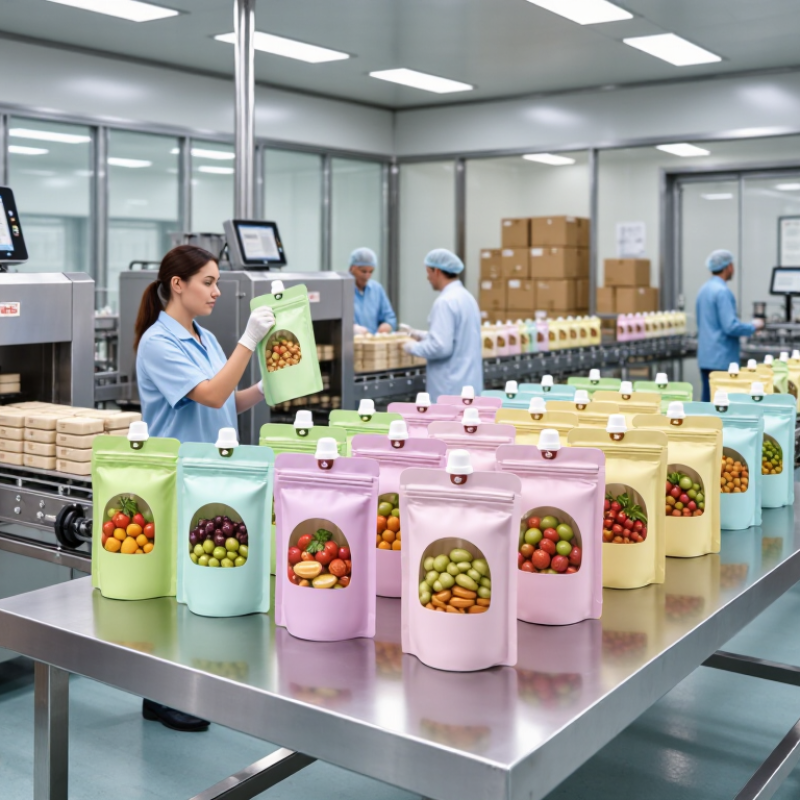
Before comparing suppliers, define the pouch you need to make. Specify its fill weight, dimensions, spout position, cap style, and whether it will hold purées, cereals, or textured meals. A pouch for smooth apple purée may not suit a thicker lentil blend. Ask suppliers to confirm material structure, oxygen and moisture barrier performance, seal strength, and compatibility with your filling and sterilization process. Small details matter. A cap that is hard for caregivers to open can undermine an otherwise sound package.
Set measurable requirements, not just preferences. Request samples and test them with your actual product: check filling accuracy, leaks, seal consistency, and how easily the pouch squeezes. Define acceptable tolerances before production. The Flexible Packaging Association’s 2023 State of the U.S. Flexible Packaging Industry report estimated the sector’s 2022 value at $42.9 billion, illustrating the scale of flexible packaging—but market size does not prove that a particular pouch fits your needs. Ask for test records and traceable material specifications. If you need recyclable packaging, state the intended collection system and ask for evidence; the word “recyclable” alone is not enough. I would also leave room for revision. Early specifications can miss how a real purée behaves in a real filling line.
Common baby food pouch formats range from approximately 90 g for smaller portions to 180 g for larger meal servings. Before comparing suppliers, define the target fill weight, material structure, spout configuration, closure type, and required shelf-life performance. These requirements help suppliers provide comparable quotations and production samples.
A reliable supplier should treat safety as a daily process, not a certificate on a wall. Ask for current HACCP or ISO 22000 records, third-party audit results, and laboratory testing for each product category. Confirm that the certificate covers the actual factory, pouch materials, and production site. A document from another facility is not enough. Check expiry dates, certification scope, and the auditor’s accreditation.
Tips: Request a recent sample pouch and inspect its seal, print quality, lot code, and smell. Ask how the supplier controls allergens, water quality, sanitation, and temperature. You can also request a mock-recall record. It should show how quickly the team traces one lot from ingredients to shipment. Keep questions specific.
Packaging safety deserves equal attention. The supplier should provide migration testing for food-contact materials and explain how damaged pouches are handled. Review incoming ingredient checks, metal detection, and finished-product release procedures. During a factory visit, notice small details: clean handwashing areas, covered ingredients, clear cleaning schedules, and separated storage zones. These details reveal habits.
Still, paperwork can create false confidence. I once viewed a well-organized compliance file that explained little about transport conditions. Ask for corrective-action reports, not only successful audit scores. Verify testing laboratories, retain samples from production lots, and compare records with physical conditions. A dependable supplier welcomes careful questions, even uncomfortable ones.
How to Choose the Best Baby Food Pouch Supplier?
When reviewing a baby food pouch supplier, compare the material before admiring the artwork. Food-grade polyethylene offers flexibility and reliable sealing. Barrier layers help protect flavor, color, and nutrients from oxygen and light. However, multilayer structures may complicate recycling. Mono-material pouches can simplify recovery, but they may need stronger barrier solutions. Ask for food-contact documentation, migration test reports, and batch traceability. Practical evidence matters more than attractive promises.
Design affects both safety and daily use. Check the spout position, cap fit, pouch stability, and seal width. A rounded pouch is easier for small hands, while a flat bottom improves shelf presentation. Tamper-evident features should be clear and difficult to remove accidentally. Test the pouch with real filling temperatures and handling conditions. Small details expose weak seals.
Customization can include size, printing, cap color, surface finish, and dispensing format. Start with samples, not assumptions. I once preferred a glossy finish because it looked premium, but fingerprints made it unsuitable for retail shelves. Minimum order quantities also deserve careful attention. Excess packaging can become expensive inventory. Request prototype samples, seal-strength results, color proofs, and production timelines. A capable supplier should explain limitations honestly, even when the answer is inconvenient.
| Evaluation Factor | Foil-Laminate Pouch | Clear High-Barrier Pouch | Mono-Material PE Pouch |
|---|---|---|---|
| Typical material structure | Often uses multiple layers such as PET, aluminum foil, and a food-contact sealant layer. Exact structures vary by application. | Often combines printable outer film with transparent barrier-coated films, such as oxide-coated PET, and a sealant layer. | Uses polyethylene-based layers designed to keep the main pouch body within a single polymer family; closures and fitments may differ. |
| Light and oxygen protection | Provides strong light and gas barrier when the laminate and seals are properly specified. | Can provide useful barrier while allowing the product to remain visible; performance depends on coating, structure, and seals. | Barrier performance depends on the film design and is not automatically equivalent to foil laminates; request product-specific test data. |
| Common design fit | Suitable to evaluate for products needing high protection from light and oxygen, subject to processing and shelf-life validation. | Useful when product visibility is part of the pack design and the required barrier can be achieved. | Worth considering when material simplification and recycling compatibility are priorities, where local collection and recycling systems accept the pack. |
| Print and appearance | Supports printed graphics; the foil layer gives an opaque appearance. | Supports printed graphics with a clear viewing area, depending on the artwork and barrier-film construction. | Supports printed graphics; confirm print method, ink suitability, and whether the design preserves the intended material structure. |
| Common pouch formats | Stand-up pouch, shaped pouch, or spouted pouch, depending on the supplier’s converting capabilities. | Stand-up or spouted formats are possible; clear areas and barrier requirements should be reviewed together. | Stand-up or spouted formats may be available; check that the pouch, fitment, and closure are compatible with the chosen material design. |
| Filling and heat-processing compatibility | Must be specified for the actual process. Retort use requires a structure, seals, and fitments validated for the intended retort conditions. | Must be validated for the filling and storage conditions; not every clear barrier film is suitable for retort processing. | Must be validated for the filling process, product, and storage conditions. Do not assume a recyclable-design pouch is suitable for hot-fill or retort. |
| Customization options | Ask about pouch dimensions, spout position, corner shape, tear features, print coverage, and finish options. | Ask about clear-window size and location, print coverage, pouch shape, fitment position, and available finishes. | Ask whether the complete pack design—including pouch layers, fitment, and closure—meets the target material specification. |
| Key trade-off | Strong protective potential, but the multi-material laminate can be difficult to recycle through conventional systems. | Offers visibility, but barrier performance and processing suitability depend on the specific coating and laminate construction. | May support material simplification, but barrier, machinability, fitment compatibility, and local recyclability need to be confirmed. |
| Questions to ask the supplier | Request the full layer structure, food-contact documentation, seal data, and written confirmation of compatibility with your filling process. | Request barrier test results, coating details, product-visibility samples, and process-specific validation information. | Request the full bill of materials, compatibility details for all components, and evidence supporting recycling claims in your target market. |
| Sample and quality checks | Test filled samples for seal integrity, leakage, drop performance, and suitability for the intended distribution conditions. | Check seals, pouch handling, barrier performance, and product appearance after filling and storage trials. | Run filling-line trials and verify seals, fitment attachment, package integrity, and the complete pack’s material specification. |
Selection note: These are packaging-material categories, not supplier performance ratings. Actual structures, barrier properties, minimum order quantities, lead times, and processing limits vary by supplier and product. Confirm food-contact compliance, test data, and compatibility with your recipe, filling process, target shelf life, and destination-market requirements before placing an order.
Choosing a baby food pouch supplier requires more than comparing prices. Production capacity should match your forecast, seasonal demand, and expected growth. Ask for monthly output, available filling lines, and backup equipment. A supplier producing 500,000 pouches monthly may struggle with a sudden 30% increase.
Visit the facility when possible. Observe raw material storage, pouch sealing, batch coding, and finished-goods handling. Reliable quality control includes incoming material checks, metal detection, seal-strength testing, and microbiological analysis. Request recent test records, inspection procedures, and clear corrective-action reports. Do not accept vague promises. Details matter.
Lead time deserves equal attention. Ask how long sampling, production, testing, and shipment each require. Confirm the standard lead time and the emergency option, but question both. In my experience, suppliers often quote production time while overlooking laboratory release or packaging delays. That gap can disrupt launches. A written schedule should identify approval points, responsible teams, and communication methods. Keep some safety stock. It costs money, but missed delivery dates can cost more. I have also learned that a flawless factory tour proves little if production records are incomplete. Request a small trial order and inspect the pouches after transport. Real performance may differ from presentation.
Assess Pricing, Communication, and Long-Term Support
A low unit price can hide costs for tooling, printing changes, testing, or rushed freight. Ask suppliers to itemize a sample order, including pouch material, filling compatibility, minimum quantities, and delivery terms. Compare like with like. A quote that excludes changeover fees may look attractive until your artwork changes. I have seen buyers focus too heavily on the first invoice; it is an easy mistake to make.
Communication matters when a production detail shifts. McKinsey’s 2024 B2B Pulse found that buyers use an average of ten interaction channels during purchasing. For a pouch supplier, that may mean email for specifications, a call about a seal issue, and a portal for order status. Agree on response times, named contacts, and how technical changes are documented. Test this before a large order: send a practical question about pouch dimensions and note how clearly the supplier responds.
Long-term support should include material guidance, sample reviews, and help tracing a production batch. Ask how the supplier handles a delayed shipment or a pouch that fails a seal check. Request written procedures, not just reassurance. Good support is specific. Still, no supplier can prevent every disruption, and promises deserve verification. Review service records and hold periodic performance checks, even when the relationship feels comfortable.
We now offer custom-made commercial vehicle tarps, along with the ability to design your own curtains, noise panels, and strip doors—tailored to your exact needs!
At Singer Safety, we specialize in manufacturing high-performance tarps engineered to safely secure and protect your vehicle loads during transport.