
How to Choose a Medical Uniform OEM Partner
Choosing a Medical uniform OEM partner is not just a price comparison. It is a decision about fit, fabric, production control, and dependable delivery. A sample may feel soft under bright showroom lights, yet grow heavy after a full shift. A seam may look neat on one jacket and twist after repeated washing. Those details matter to nurses, technicians, and procurement teams who rely on uniforms every day.
Quality-management expert W. Edwards Deming offered a useful principle: “Quality comes not from inspection, but from improvement of the production process.” Deming was not a medical-apparel specialist, so his words are best applied here as a quality framework. A capable OEM partner should explain how it checks fabric weight, color consistency, stitching, sizing, and batch variation. Ask to review a production sample, measurement chart, and realistic lead-time plan. Request clear answers about fabric substitutions and how defects are handled. Small checks. Big consequences.
This guide outlines how to assess those capabilities before committing to an order. It considers manufacturing experience, customization, communication, quality assurance, and order flexibility. A polished catalog is useful, but it cannot prove reliable production. Nor does one successful sample guarantee every later batch will match. That uncertainty deserves attention. Compare evidence, ask specific questions, and record agreed specifications before production begins. The right partner should welcome that scrutiny, not rush past it.
Define Scrubs, Lab Coats, and Protective Gowns Before Setting Requirements
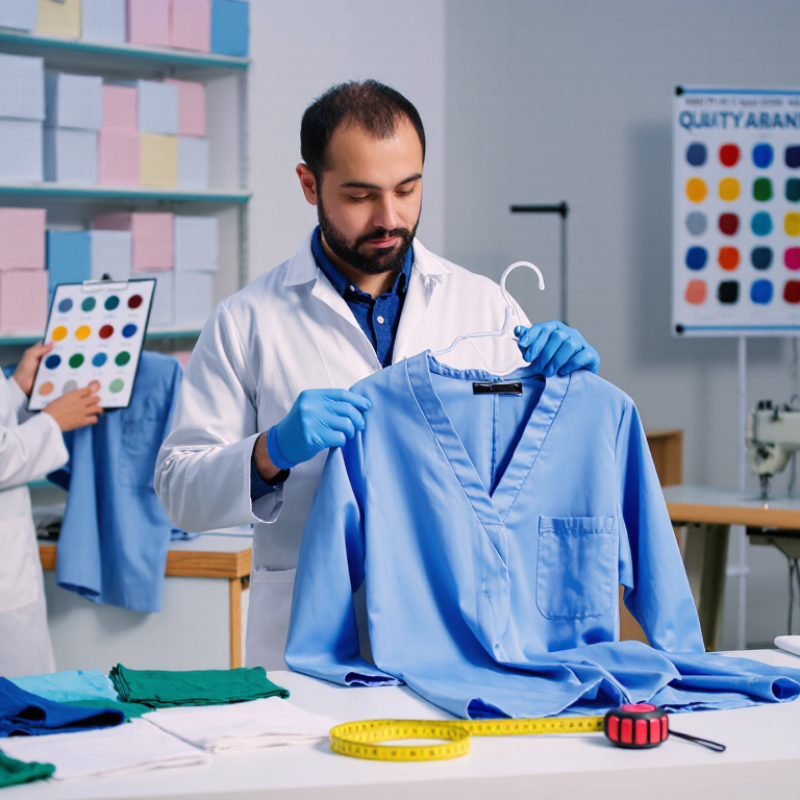
Before requesting samples from a medical uniform OEM partner, define what each garment must do. Scrubs are daily workwear, often worn through long shifts and frequent movement. Note the required fit, pocket placement, fabric weight, stretch, and laundering conditions. A nurse reaching for a pen needs a pocket that stays accessible, not one that looks good only on a sketch.
Lab coats need a different brief. Specify sleeve length, closure type, pocket depth, and the clothing worn underneath. A coat for routine bench work may need different coverage from one used in a teaching lab. Be precise about the intended environment; “standard lab coat” can mean very little. I have seen teams assume one pattern suits everyone, then discover that cuff fit or coat length causes daily frustration.
Protective gowns should be defined by the task and the level of coverage required, not by appearance alone. Describe sleeve and back coverage, closure method, material feel, and whether the gown is disposable or reusable. Share relevant performance requirements with the OEM partner and ask how samples will be checked. Small details matter. A tie that loosens or a sleeve that rides up can change how a garment works in practice. Requirements may need revision after staff try on samples, and that is not a failure; it is useful feedback.
How to Choose a Medical Uniform OEM Partner - Define Scrubs, Lab Coats, and Protective Gowns Before Setting Requirements
| Garment category | Typical purpose and wearer | Coverage and design inputs | Material and performance requirements | OEM specifications to define | Key verification points |
|---|---|---|---|---|---|
| Scrubs | Everyday workwear for clinical staff in settings such as hospitals, clinics, and laboratories. Scrubs are not automatically protective equipment. | Usually a short-sleeve top with trousers; specify neck shape, sleeve length, pocket layout, waistband, drawcord, and desired fit. | Choose fabric for the intended wear frequency, comfort, opacity, color retention, and laundering conditions. Common options include woven cotton-polyester blends and other durable textile blends. | Provide garment measurements, size range, grading rules, fabric composition, color standards, seam construction, pocket dimensions, labeling, and packaging requirements. | Check fit across the full size range, seam strength, shrinkage, colorfastness, and performance after the expected laundering process. Define whether facility laundering or home laundering is anticipated. |
| Lab coats | Workwear used by laboratory, clinical, and research personnel to cover personal clothing. A standard lab coat should not be assumed to provide chemical, biological, or liquid protection. | Specify coat length, collar or lapel, sleeve style, closure type, pocket arrangement, and whether cuffs are open or fitted. | Select fabric and construction according to the actual workplace hazards and laundering needs. A conventional fabric coat is not a substitute for task-specific protective clothing. | Define intended work setting, coverage, fit, closure, pocket placement, fabric composition, color, garment length, size grading, and care instructions. State any required hazard-specific testing separately. | Confirm the garment’s intended-use limits with the organization’s safety requirements. If chemical or biological protection is needed, assess the specific hazard and applicable protective-clothing standards rather than relying on the “lab coat” description. |
| Protective gowns | Disposable or reusable garments intended to provide a specified level of protection for a defined healthcare task. Isolation gowns and surgical gowns have different intended uses and requirements. | Specify the areas requiring coverage, such as the front, sleeves, and back; also define neck and waist closures, cuff design, and donning method. | Set barrier performance based on anticipated exposure to fluids or other hazards. For applicable U.S. healthcare gowns, ANSI/AAMI PB70 classifies liquid-barrier performance into Levels 1–4; the required level depends on intended use. | Identify gown type and intended use, required barrier level where applicable, reusable or disposable construction, material, seam and closure design, size range, labeling, packaging, and any applicable regulatory requirements for the target market. | Request evidence supporting the specified barrier claims and confirm that testing covers the relevant garment areas and construction. For reusable gowns, define laundering, reprocessing, and performance checks over the intended service life. |
Requirement-setting tip: Define the wearer, work task, exposure risk, laundering or disposal pathway, target market, and required garment performance before requesting samples or quotations. A garment category alone does not establish its protective capability.
 '
