How to Choose a Plastic Bookshelf in 2026?
Choosing a Plastic Bookshelf in 2026 means balancing everyday convenience with stability, capacity, and material quality. A narrow unit may fit beside a desk, yet wobble when heavy books fill its upper shelves. A glossy finish can look convincing online. It tells you little about the joints, shelf thickness, or weight limits. Measure your space, check the stated load capacity, and consider where the unit will stand.
Material choices also deserve attention. The OECD’s Global Plastics Outlook reports that global plastic production reached 460 million tonnes in 2019. The same report estimates that 353 million tonnes of plastic waste were generated, and only 9% was recycled. These figures describe plastics broadly, not bookshelves specifically. Still, they make durability and product lifespan reasonable parts of the buying decision. A low price matters less if a shelf cracks after one move.
Furniture designer Charles Eames said, “The details are not the details. They make the design.” For a Plastic Bookshelf, those details include reinforced corners, secure connectors, smooth edges, and shelves that remain level under load. This guide will compare size, construction, stability, maintenance, and value to help you choose with care. There is no perfect option. A practical choice should fit your room, your books, and the limits you are willing to accept.
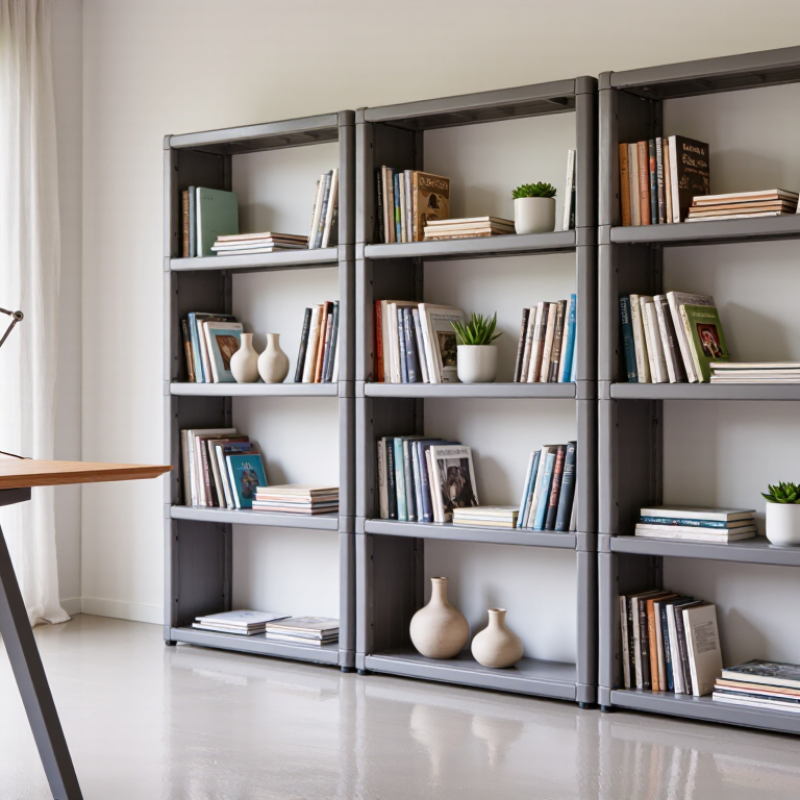
Define Space, Book Weight, and the Shelf Capacity You Need
Start with the space, not the shelf. Measure the floor area, ceiling height, and available depth. Include baseboards, nearby doors, and the path used to carry books into the room. A shelf that fits on paper may still block a door or feel awkward beside a desk. Small details matter.
Next, estimate the weight your books will place on each level. Paperbacks are relatively light; large textbooks, art books, and reference volumes can be much heavier. Check the stated capacity for each shelf, not only the unit’s total limit. Those numbers are useful, but they may assume evenly distributed weight. A row of heavy books on one end can make a plastic shelf bow sooner than expected. Spread heavier volumes across the shelf and place them lower.
Match the capacity to how you actually read and store books. Leave a little room for new purchases, but avoid choosing a tall unit just because it offers more space. Check that the shelves lock securely and that the unit sits level on your floor. If the floor slopes slightly, even a sturdy-looking bookcase can wobble. I would measure twice, then still expect to adjust the layout once the books are in place. That’s normal.
How to Choose a Plastic Bookshelf in 2026? — Define Space, Book Weight, and the Shelf Capacity You Need
| Use Case | Suggested Unit Footprint
(W × D) | Usable Shelves | Example Books per Shelf | Estimated Load per Shelf | Minimum Rated Capacity to Look For
(per shelf) |
| Small nook; mostly paperbacks | 55 × 28 cm
(21.7 × 11.0 in) | 4 | 10 paperbacks at about 0.7 lb (0.32 kg) each | About 7 lb (3.2 kg) | At least 9 lb (4.0 kg) |
| Bedroom; mixed paperbacks and hardcovers | 75 × 30 cm
(29.5 × 11.8 in) | 5 | 15 books at about 1.5 lb (0.68 kg) each | About 22.5 lb (10.2 kg) | At least 29 lb (13.1 kg) |
| Study; heavier hardcover collection | 85 × 35 cm
(33.5 × 13.8 in) | 5 | 20 hardcovers at about 2.2 lb (1.0 kg) each | About 44 lb (20.0 kg) | At least 55 lb (25.0 kg) |
| Reference area; textbooks and large volumes | 95 × 35 cm
(37.4 × 13.8 in) | 5 | 25 textbooks at about 3 lb (1.36 kg) each | About 75 lb (34.0 kg) | At least 94 lb (42.6 kg), or divide the books between shelves |
Planning note: These are example load calculations, not universal plastic-shelf ratings. Book weights vary, and a shelf’s safe capacity depends on its design, assembly, and load distribution. Check the manufacturer’s stated capacity for each shelf, measure your available width and depth, and leave room for airflow and access. The capacity targets above include an approximately 25% allowance over the estimated book load.
Compare PP (#5) and HDPE (#2) Resin Codes When Choosing Plastic
How to Choose a Plastic Bookshelf in 2026?
When comparing plastic bookshelves, check the molded resin code: PP is #5, while HDPE is #2. The code identifies the plastic, not the shelf’s strength or quality. PP is often lightweight and fairly rigid, which can suit narrow shelves holding folded clothes or small books. It may feel less forgiving if a shelf is struck or flexed repeatedly. HDPE is generally tougher and more impact-resistant, with a little more flexibility. That can help in busy rooms. Neither resin guarantees a sturdy bookshelf.
Inspect the actual design. Press gently near the center of a shelf and look for sagging, thin corners, or loose joints. A thicker panel with supporting ribs may carry weight better than a thin panel, regardless of its resin code. Check the maker’s stated load limit, and spread books across the shelf rather than stacking them in one spot. Details matter.
Room conditions matter, too. Direct sunlight and temperature swings can affect plastics over time, so avoid placing a shelf beside a hot radiator or a sunny window. For a damp laundry area, both PP and HDPE can resist moisture, but seams and fasteners still deserve a close look. I would not choose by code alone; it is an easy shortcut, but not always a good one. A small wobble in the store is worth noticing.
Assess Flexural-Strength Claims Using ASTM D790 Test Methods
When choosing a plastic bookshelf, treat flexural-strength claims as test results, not shelf-load guarantees. ASTM D790 measures flexural properties by supporting a specimen at two points and applying force between them. Check the report for strength in MPa, specimen thickness, support span, test speed, and conditioning. Without these details, two numbers may not be comparable. A short laboratory bend test also cannot show how a loaded shelf will sag over months.
Context matters. Plastics Europe’s Plastics – the Fast Facts 2024 report estimates global plastics production at 413.8 million tonnes in 2023. That scale reflects many different materials; it does not mean every plastic has the same stiffness or quality. Ask whether the tested resin matches the bookshelf’s material and whether the whole shelf was tested. A high D790 value alone does not establish a safe load limit. I’d still want clearer real-use evidence.
Tips: Compare like with like. Look for shelf-span and load-test data, and inspect the underside for ribs or supports. Put heavy books near the sides, not in the middle. Small detail, big difference. If the seller provides only a strength number, treat it as incomplete evidence.
Check Storage-Unit Stability and Durability Against ISO 7170
How to Choose a Plastic Bookshelf in 2026?
A plastic bookshelf can seem sturdy when empty, then bow under a row of heavy textbooks. ISO 7170 provides test methods for assessing storage-unit strength and durability. It does not guarantee that every shelf suits every room or load. Ask for test documentation for the exact model and configuration, including the tested loads and any observed damage.
Look closely at shelf thickness, support points, and connectors. Small details matter.
Stability deserves a separate check. ISO 7171 addresses storage-unit stability, so do not treat an ISO 7170 report as proof of stability testing. Ask whether the unit was assessed for both strength and resistance to tipping.
At home, place it on a level floor and load heavier items on lower shelves. Watch for rocking, sagging, or loose joints.
No test captures every household condition. Sunlight, heat, uneven flooring, and years of use can change how plastic performs. A careful choice still needs occasional inspection.
Match Rated Load and Shelf Span to Your Collection’s Needs
A plastic bookshelf’s load rating matters only when you know what it applies to. Check whether the stated limit is per shelf or for the entire unit. Add up the approximate weight of the books you plan to store, then leave a margin rather than loading every shelf to its maximum. Hardcovers can become surprisingly heavy in a short row. A small kitchen scale can help estimate a stack if the rating is unclear. Still, weighing every book is probably overkill.
Shelf span matters just as much as rated load. A long, unsupported shelf may bow under books, even when the total weight seems acceptable. Measure the clear distance between supports and compare it with the span recommended for the unit. If that detail is missing, treat a wide shelf cautiously. Watch for a curve after loading, and move some books if one appears.
Distribute weight across the shelf instead of placing a dense stack at its center. Put heavier volumes near the sides or supports, and avoid leaning on the shelf while reaching. Plastic can flex more noticeably than expected; that does not always mean it is failing, but it is worth checking. Recheck the unit after a few days, especially on uneven flooring. Ratings assume particular conditions, and real rooms are rarely perfect.
How to Choose a Plastic Bookshelf in 2026?
Match the rated load and shelf span to your collection—not just the number of books.
Approximate planning estimates for ten books: actual weights vary by size and edition. Weigh a representative stack to estimate your collection’s load, then choose a shelf rated for at least that much at the intended shelf span, with extra capacity for uneven loading. Longer spans can sag more, so check the product’s stated load limit for that exact span and distribute heavy books evenly.

 '
