How to Create custom cigar labels for Your Brand begins with a practical question: what should a customer notice before opening the box? A well-designed label can express your brand’s character while helping each product look consistent on a shelf or display. Custom cigar labels work best when color, typography, and material support one clear identity rather than compete for attention. Think of a deep green band, restrained gold accents, and lettering that remains readable under warm shop lighting.
Start by defining the audience, brand story, and product details that belong on the label. Then choose a size and layout that fit the cigar without covering important features or making the band difficult to handle. Paper texture, foil, embossing, and matte finishes can change how a label feels in the hand. Request printed samples before approving a large run. Small color shifts can look obvious beside a reference swatch. Test it.
Keep details accurate and easy to verify. Confirm spelling, dimensions, print colors, and any required product information with qualified suppliers or advisers familiar with the markets where the product will be offered. Labeling expectations can vary, so do not rely on a design template as a compliance check. A useful design process includes testing, feedback, and revision. It may take another round. That is normal. This guide explores the choices behind effective cigar labels, from early concepts to print-ready files, while recognizing that attractive packaging still needs careful review and honest brand communication.
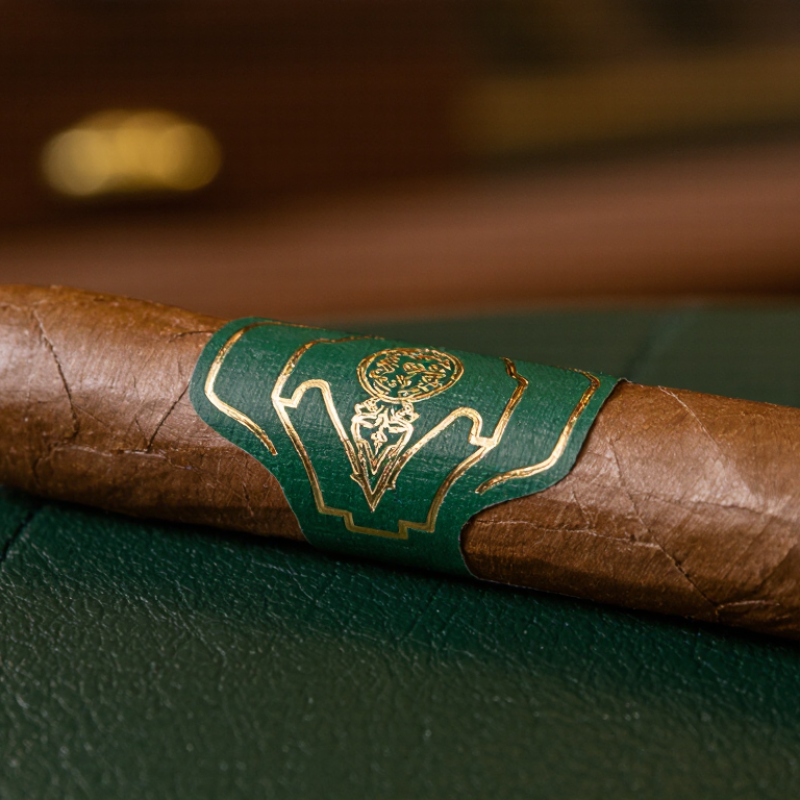
Before designing a cigar label, define what your brand should communicate: tradition, craft, modern simplicity, or another clear idea. Write a short description of your intended customer and the feeling you want the label to create. Specifics help. “Refined and calm” is more useful than “premium.” Choose a small set of colors, type styles, and visual details that support that direction.
Record the practical requirements before choosing artwork. Measure the band area, note the product sizes it must fit, and confirm how the label will be applied. Decide which details need to appear, such as the product name, size, origin, or required notices. Check current packaging rules for the places where the product will be sold. Keep key text readable at actual print size. A design that looks sharp on a large screen may become cramped on a narrow band. The first draft may not work; leave room to revise it.
Tips: Print a test at full size and wrap it around a sample. Check small lettering, color contrast, and alignment under ordinary lighting. Ask a few people to read it without explanation. If they miss an important detail, simplify the layout.
Before choosing colors or foil, confirm the rules where your cigars will be made and sold. Label laws vary by country, state, and product type, and exemptions can be narrow. In the United States, FDA requirements may cover health warnings, packaging, and advertising. Check current FDA guidance rather than relying on an old printer’s template. This detail is easy to miss.
Build a compliance checklist before artwork begins. Depending on the market, required details may include product identity, manufacturer or importer information, quantity, origin, and prescribed health warnings. Confirm the warning text, size, placement, and language with the relevant regulator. Keep supporting records, including approved artwork and supplier specifications. A beautiful label can still fail a basic review.
Clear information matters. The CDC’s 2023 National Youth Tobacco Survey reported current cigar use among 1.6% of U.S. middle and high school students. That figure is a reminder to avoid designs or wording that could appeal to minors. Review every draft at actual print size; tiny type can become unreadable on a curved cigar band. I’d also ask a compliance professional to check the final proof. One overlooked line is enough.
| Label Area | Information or Design Element | Practical Example | Compliance Check |
|---|---|---|---|
| Product identification | Clearly identify the product as a cigar or cigar product. | “Handmade cigar” or “Cigar” | Use an accurate product description and check the terminology required in each market where the product will be sold. |
| Health warnings | Include any warning statements and prescribed presentation required for the destination market. | Use the exact warning text specified by the applicable regulator; do not paraphrase it in the artwork. | Requirements can depend on jurisdiction, product type, package, and current legal status. Confirm the applicable rules before printing. |
| Warning placement and legibility | Reserve sufficient space for required warnings and keep them easy to read. | Proof the final-size label on a package mock-up, not only on a screen. | Check applicable rules for warning size, placement, contrast, rotation, and language. Do not assume one layout rule applies worldwide. |
| Quantity or count | State the package quantity or other net-quantity information when required. | “5 cigars” | Verify the required unit, wording, location, and measurement rules for the sales jurisdiction and package type. |
| Responsible party | Provide manufacturer, packer, distributor, or importer details when required. | Use the legally appropriate business name and postal address for the responsible party. | Confirm which party must appear on the label and whether a full street address or another format is required. |
| Country of origin | Show origin information when required, particularly for imported goods. | “Made in [country]” | Check the origin-marking rules for the destination country and ensure the statement is accurate and legible. |
| Ingredients and product disclosures | Review ingredient, additive, and tobacco-product disclosure obligations. | Prepare an approved product-information record before finalizing label copy. | Disclosure or reporting duties do not necessarily mean every ingredient must appear on the consumer label. Confirm the specific rules that apply. |
| Tax and excise markings | Allow for any required tax stamp, excise mark, or jurisdiction-specific identifier. | Keep a clear, unobstructed area on the package if a stamp must be applied separately. | Requirements may vary by country, state, province, or locality; verify them with the relevant tax authority. |
| Lot or batch identification | Add a traceability code where required or used for production control. | “Lot: 24A01” | Set a consistent coding method and check whether local rules specify format, placement, or recordkeeping. |
| Product details | Use optional factual details to help distinguish product formats. | Wrapper type, cigar count, or dimensions, if verified. | Keep descriptions accurate and avoid wording that could mislead consumers about composition, origin, or product characteristics. |
| Claims and promotional wording | Review health, safety, reduced-risk, and modified-risk claims before use. | Avoid unsupported statements such as “safer” or claims implying a health benefit. | Tobacco-product claims can be restricted or require prior authorization. Have proposed claims reviewed under the applicable laws. |
| Artwork and print proof | Check contrast, text size, package fit, and reserved legal-information areas. | Approve a full-size print proof showing folds, seams, and any over-labels. | Ensure required text remains visible and legible after the label is applied to the final package. |
Note: Labeling obligations differ by country and may change. Confirm current requirements with the relevant regulator or qualified legal counsel before production.
A cigar label should feel considered in the hand and remain legible on a curved surface. Start with the material: textured, uncoated paper gives a tactile, traditional feel, while coated paper supports sharper color and detail. Synthetic stock can resist moisture and scuffing, but may feel less natural. Grand View Research’s 2024 label-market report valued the global label market at USD 45.5 billion in 2023 and projected 5.4% annual growth through 2030. That broad industry figure signals demand for varied label solutions, not a reason to overdecorate one.
Measure the cigar’s circumference and the available band area before setting label dimensions. Leave enough overlap for secure application, but keep the seam away from key lettering. Test a paper mock-up on the actual wrapper; a flat proof can hide wrinkles and awkward spacing. Small details matter. For finishing, foil can add a restrained highlight, embossing gives raised texture, and a matte varnish reduces glare. Gloss may deepen color, yet it can make fine text harder to read under bright retail lights. A useful specification includes stock, adhesive, dimensions, color, and finish, with a sample checked for adhesion and handling. There is no perfect combination; a heavier stock may feel premium but can be harder to wrap cleanly. I would treat that trade-off as a design question, not a defect to disguise.
Compare the area of three sample label formats to help plan artwork and material use.
Areas are calculated from the sample dimensions shown (width × height); these are examples, not industry standards. Choose paper for a classic look or synthetic film where moisture resistance is important. Matte or gloss coatings and foil accents can add different visual effects.
Creating a cigar label begins with the real object, not just a screen mockup. Measure the band against the cigar’s curve, then check how the artwork sits where the ends meet. Keep the product name, origin details, and required market-specific text easy to read. Small type can look elegant on a monitor and disappear on textured paper. Details matter.
Paper and Packaging Board consumer research from 2018 reported that 72% of consumers said packaging design could influence their purchasing decisions. Treat that as a reason to test clarity, not as a promise of sales. Prepare two or three distinct layouts, then review hierarchy, contrast, and legibility at actual print size. Use a physical proof on the intended stock. Foil, embossing, and dark inks can shift appearance under warm retail lighting.
Before approval, check spelling, dimensions, color references, and any required copy with a qualified reviewer. Ask someone unfamiliar with the design to identify the key information in a few seconds. Their hesitation may expose a weak point. I would not approve a proof based only on a polished digital preview; even a careful process can miss a cramped line or an awkward seam. Keep dated versions and record who approved the final file.
Before sending cigar labels to print, confirm the finished size on the actual wrapper. Measure its usable panel, including any curve or overlap, then add bleed and safe margins according to the printer’s specifications. Keep important text away from trim edges. Check twice.
Choose a label stock that suits the wrapper’s texture and handling conditions. A paper sample may look excellent on screen but wrinkle on a curved surface. Ask the printer about adhesive compatibility, finish, and color matching. Request a physical proof, especially when small text or fine lines matter. Compare it under neutral light, since warm lighting can make colors appear richer than they are. Even a careful proof can miss a tiny spacing issue.
Before approving the full run, test a few labels on clean, dry wrappers. Apply each one slowly, pressing from the center outward to limit bubbles and creases. Check whether the edges lift after handling and whether the label sits straight across the seam. Record the room conditions and application method, so a successful test can be repeated. If the result is imperfect, adjust the artwork or adhesive before printing more. A rushed test is still useful, but it may not reveal how labels behave after storage.
We now offer custom-made commercial vehicle tarps, along with the ability to design your own curtains, noise panels, and strip doors—tailored to your exact needs!
At Singer Safety, we specialize in manufacturing high-performance tarps engineered to safely secure and protect your vehicle loads during transport.