Why Choose LED High Bay Lights for Warehouses?
A warehouse floor demands more than bright fixtures. Forklift aisles, tall racks, loading bays, and inspection benches all need useful, consistent light. A well-designed Led High Bay Light can deliver that illumination while using less electricity than many older lighting systems. The details matter. Beam angle, mounting height, glare control, and color quality shape what workers actually see.
The U.S. Department of Energy’s Energy Saver guidance reports that LEDs use at least 75% less energy and last up to 25 times longer than incandescent lighting. That comparison is not a direct promise of savings over every warehouse fixture; actual results depend on existing equipment, operating hours, controls, and installation. Still, fewer lamp replacements can mean fewer lifts, less maintenance disruption, and lower disposal needs. Small operational gains add up.
Lighting researcher Dr. Mariana Figueiro’s work highlights an important consideration: light affects people, not just rooms. That is a useful lens for warehouse upgrades, where visibility, comfort, and task demands belong in the same discussion as energy use. Better lighting is not automatically better lighting. Poorly aimed high bays can create glare on polished floors or leave dark bands between racks. A careful audit should measure conditions at working surfaces and review controls, maintenance, and fixture placement. Results vary. This article explores why warehouses choose LED high bays—and what to check before replacing a single fixture.
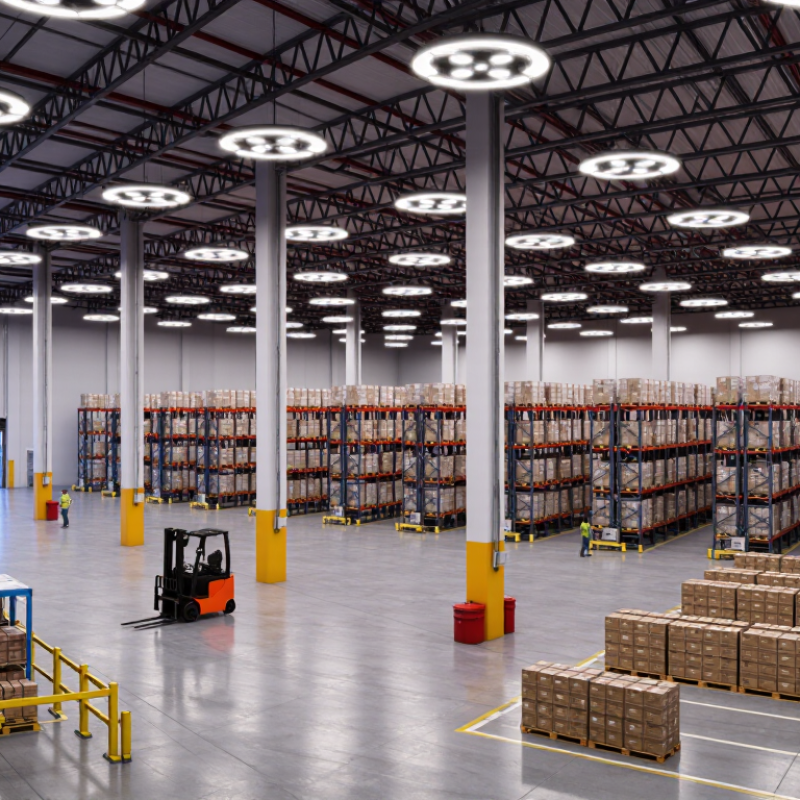
Warehouse high bays are fixtures designed for elevated mounting, commonly at ceiling heights of 20 feet or more. The height matters: light must travel farther to reach pallets, floor markings, and work surfaces. A narrow aisle may need a different beam spread from an open loading area. Not a hard boundary. Actual selection depends on mounting height, rack layout, and the brightness required for each task. A useful check is to map the fixture locations against the darkest aisle corners, not just the open floor.
LEDs can reduce energy use, but comparisons need care. The U.S. Department of Energy’s LED Lighting factsheet reports that LEDs use at least 75% less energy than incandescent lighting; that figure is not a direct comparison with warehouse HID fixtures. DOE’s 2020 U.S. Lighting Market Characterization also tracks the broad shift toward LED lighting across buildings, though results vary by application. In practice, compare measured input watts and light levels for the existing and proposed fixtures. Check glare from the floor and visibility on the top rack shelf, too. A photometric layout helps, but site conditions can still surprise you. Measure first.
LED high bay lights are judged partly by luminous efficacy, measured in lumens per watt (lm/W). It shows how much light a fixture produces for each watt of electricity it uses. In a warehouse, that figure helps compare energy use across fittings with similar light output. A higher value can mean less power is needed to illuminate aisles and work areas.
For example, a 150-watt fixture rated at 150 lm/W produces about 22,500 initial lumens. At 120 lm/W, the same wattage produces about 18,000 lumens. That difference looks clear on paper. Still, rated output alone cannot show how evenly light reaches a floor, rack face, or packing bench. Lens design, mounting height, and beam angle affect usable illumination.
Compare efficacy figures under similar conditions, including color temperature and color rendering. Check independent photometric data when available, then review the proposed layout for dark gaps and glare. A narrow beam may deliver strong readings beneath a fitting but leave nearby shelving dim. Light output can also decline as components heat up or age. I would not choose a fixture by its headline lm/W alone; that shortcut is easy, and it can miss what workers actually see.
| Lighting technology | Typical fixture efficacy (lumens per watt) | Representative efficacy used | Approx. input power for 30,000 lumens | Potential energy saving with LED* | Warehouse performance considerations |
|---|---|---|---|---|---|
| LED high bay | 130–170 lm/W | 150 lm/W | 200 W | — | High efficacy, instant-on operation, and good controllability. Actual results depend on the fixture, optics, driver, and operating conditions. |
| Metal-halide high bay | 70–100 lm/W | 80 lm/W | 375 W | About 47% | Traditional option, but output can depreciate over time; warm-up and restrike delays may also affect operation. |
| Fluorescent high bay | 80–100 lm/W | 90 lm/W | 333 W | About 40% | Can provide diffuse light, but performance and maintenance needs vary by lamp, ballast, temperature, and fixture design. |
| High-pressure sodium | 90–150 lm/W | 110 lm/W | 273 W | About 27% | Can be efficient, but its typically warm color and lower color-rendering quality may be less suitable where color identification matters. |
How to read the comparison: Fixture efficacy is luminous output divided by electrical input power (lm/W); higher values mean more light per watt. Example power is calculated as 30,000 lumens ÷ the representative efficacy. Savings compare that example with the 200 W LED case. Ranges are indicative industry values, not guaranteed specifications; check tested fixture data for a specific installation.
Why Choose LED High Bay Lights for Warehouses?
Warehouse lighting runs for long hours, so even small efficiency gains can matter. The U.S. Department of Energy’s benchmark says LEDs use at least 75% less energy than incandescent lamps. That is substantial. However, this comparison is not a direct estimate of savings when replacing fluorescent or metal-halide high bays. Actual results depend on the existing fixtures, operating hours, light levels, and controls. A careful site assessment beats a neat guess.
Tips: Check fixture wattage and measured light levels before choosing replacements. Note operating hours, too. Sensors may help in aisles with little traffic, but poor placement can leave work areas dim.
LED high bays can provide focused, consistent light across tall storage areas, helping staff read labels and spot obstacles. Ask for photometric data and compare it with the layout, rack height, and task needs. A quick payback estimate can look convincing on paper, yet omit installation costs or reduced operating hours. Measure the current setup, keep the assumptions visible, and review results after installation. Real warehouses are messy; one aisle may need different coverage than another.
DOE benchmarks indicate that LEDs use at least 75% less energy than incandescent lamps.
Illustrative energy-use index based on the DOE benchmark: incandescent lamps = 100; LED lamps = 25 or less. This is a general comparison, not a warehouse-specific measurement.
Warehouse lighting works best when coverage is planned around the actual ceiling and work layout. Record mounting height from the floor, then check rack tops, beams, and suspended equipment that may block light. At greater heights, a narrower beam can help deliver light to the floor; at lower heights, a wider distribution may reduce harsh bright spots. Beam angle alone is not enough, so review the fixture’s photometric data and model the proposed spacing.
Set an illuminance target that fits the work, such as picking labels, moving pallets, or inspecting small parts. Aisles often need different coverage from open storage zones. Space fixtures so their light patterns overlap at the working plane, and avoid placing a row where tall shelving creates deep shadows.
Measure twice. Real floors differ.
Dust, dark surfaces, and changing rack layouts can affect results, even when a plan looks balanced on screen. After installation, use a light meter at floor and task height to check for dim patches and excessive contrast. Adjust spacing or aiming where needed; the first layout may not be perfect.
In a warehouse, relamping can mean lifts, blocked aisles, and extra labor. Longer-lasting fixtures can reduce how often crews face that disruption. The U.S. Department of Energy’s Energy Saver guidance says LED bulbs can last up to 25 times longer than incandescent lamps. That benchmark is useful, but it is not a promise that every high-bay fixture will reach the same lifespan. Warehouse conditions matter. Heat, dust, switching frequency, and driver quality can all affect service life.
LED high bays also use less electricity than incandescent lighting, according to the DOE, while delivering focused light for tall ceilings and work areas. The comparison needs context: many warehouses replace fluorescent or high-intensity discharge fixtures, not incandescent lamps. Actual savings depend on the existing system, operating hours, and controls. A fixture that looks efficient on paper may disappoint if it creates glare or leaves dark patches between racks. Small details count.
Tips: Check the fixture’s rated lifetime and warranty, then compare them with the actual warehouse environment. Review light levels at floor and rack height before ordering. Keep a few spare drivers if downtime is costly. And remember: “up to” is not typical. DOE’s 25× figure is a benchmark, not a guarantee.
We now offer custom-made commercial vehicle tarps, along with the ability to design your own curtains, noise panels, and strip doors—tailored to your exact needs!
At Singer Safety, we specialize in manufacturing high-performance tarps engineered to safely secure and protect your vehicle loads during transport.