China Top Round Counter Stools Suppliers?
China has a broad furniture manufacturing base, but choosing a supplier takes more than comparing catalog photos. Round Counter Stools appear simple. Yet seat diameter, frame strength, footrest height, finish consistency, and packing quality all affect daily use. Small details matter.
This introduction frames a practical guide to finding China-based suppliers for residential, hospitality, and commercial projects. Rather than declaring one company “the best” without verified, current evidence, the guide should explain how to compare manufacturers on product range, customization, production capacity, sample quality, communication, and documented quality controls. Ask for clear specifications, material details, lead-time estimates, and recent production photos. Request a sample when the order size justifies it. Then check its stability, welds or joints, edge finishing, and packaging—not only its appearance.
For metal models, inspect tube thickness and coating coverage. For wood or upholstered versions, review joinery, fabric durability information, and cleaning guidance. Clarify whether quoted prices include cartons, labeling, or delivery to your destination. These points can prevent avoidable surprises.
Look beyond the lowest quote. A low price can hide thinner metal, inconsistent finishes, or unclear shipping terms. That is not always the case, but it deserves attention. Buyers should confirm dimensions against their counters and intended users, since “counter height” is not a universal measurement. This guide will help readers build a shortlist, prepare useful questions, and assess supplier claims with care. Results can vary by model and order. Verify before committing.
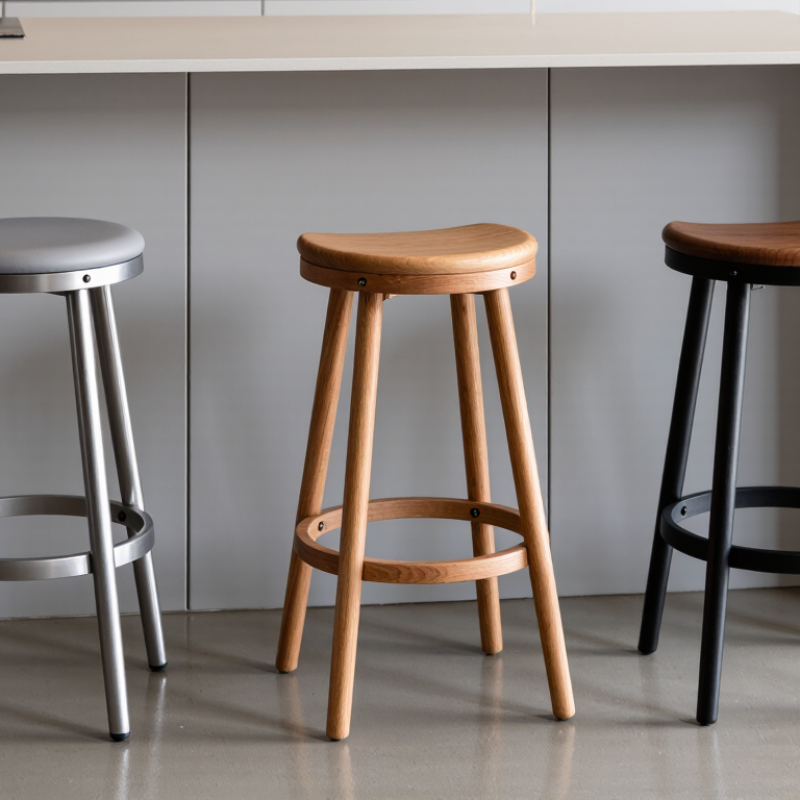
Counter-Stool Basics: 34–36-Inch Counters Pair with 24–27-Inch Seats
China Top Round Counter Stools Suppliers?
Counter-Stool Basics: 34–36-Inch Counters Pair with 24–27-Inch Seats
For a 34–36-inch counter, a seat height of 24–27 inches usually leaves comfortable legroom. Measure from the floor to the top of the seat, not to the stool frame. Aim for roughly 9–12 inches between the seat and counter underside. Aprons and thick countertops can reduce that space, so check the actual clearance before ordering. Small details matter.
Round seats are easy to arrange around a kitchen island, but diameter affects how many stools fit. Allow about 24–30 inches of counter width per seat, then check whether people can sit and move without bumping elbows. Ask suppliers for seat diameter, overall height, footrest position, and material specifications. A clear dimension drawing is useful. Photos alone can be misleading. For bulk orders, request a sample or confirm how measurements are checked during production.
Tips: Measure twice. Include the counter overhang and any support brackets. If several people will use the stools, consider footrests and a stable base; a sleek shape is not always comfortable after a long meal. Supplier replies can sound precise while leaving out practical details, so ask for written dimensions and packaging information before confirming the order.
Counter-height surfaces are typically 34–36 inches tall and pair with stools with 24–27-inch seats. For comfortable seating, aim for about 10–12 inches of clearance between the seat and the underside of the counter.
Round-Seat Fit: Allow 10–12 Inches Between Seat and Counter
China Top Round Counter Stools Suppliers?
When comparing round counter stools, check the seat-to-counter gap before choosing a style. Aim for 10–12 inches between the top of the seat and the underside of the counter. Measure the underside, not just the counter’s upper surface. A thick apron can reduce knee room, even when the counter looks high enough.
For example, a 36-inch counter paired with a 25-inch seat leaves 11 inches of clearance. That is a useful starting point, not a guarantee of comfort. Seat cushioning may compress, and finished stool height can vary slightly. Ask suppliers for the measured height from floor to the top of the seat, plus the product’s manufacturing tolerance. Small gap, big annoyance.
A round seat also needs room side to side. Check its diameter against the counter overhang and nearby stools, so knees do not bump together. If possible, test a sample at the actual counter; photos rarely show how an apron affects leg space.
One detail is easy to miss: a footrest helps, but it cannot fix a seat that sits too high. There is no perfect measurement for every household, so record the counter’s underside height and verify the fit before confirming an order.
China Supplier Checks: Compare Materials, Welding, Finishes, and Capacity
For round counter stools, a polished catalog photo is only a starting point. Ask whether the seat is solid wood, plywood, molded plastic, or upholstered, and request clear material specifications. Check the underside and edges for rough cuts, loose staples, or uneven padding. A thin seat may flex with regular use. It happens.
Inspect the frame where the legs meet the footrest and seat supports. Welds should be consistent, without obvious gaps, sharp spatter, or uneven grinding. Look closely. A clean surface finish matters, but it can hide flaws, so ask how the steel is prepared before coating. Check sample stools under bright light for bubbles, bare spots, and color variation. One sample is useful, though it cannot represent every production batch.
Capacity means more than a large workshop. Ask about monthly output, current orders, sample timing, and how production is checked between batches. Request a realistic lead-time range, not just the fastest possible date. If available, review recent production records or arrange a video walkthrough of the relevant line. Photos help, but they are not proof. I would also compare a finished sample with the written specification; small differences can slip through, and that is worth discussing before a large order.
Quality Verification: Assess Domestic Stools Against EN 12520 Test Criteria
China Top Round Counter Stools Suppliers?
When assessing domestic round counter stools, use EN 12520 as a practical reference for seating strength, durability, and safety. Request a test report for the exact stool model, not merely a similar product. Check that it identifies the tested materials, construction, and configuration. A change in frame thickness or seat attachment can affect performance.
Look closely at the test scope and results. Inspect the stool’s welds, fasteners, seat edges, and footrest for visible defects. Confirm that the base remains stable under normal use and that the seat does not loosen after repeated loading. A polished report is not the same as a comfortable stool. It may also be worth checking counter height and footrest position with a sample; these details can be overlooked during document review.
Tips: Ask for the full report and its date. Match the sample to the tested specification. If anything differs, ask the supplier or an independent laboratory whether further testing is needed. Don’t assume. EN 12520 verification supports a quality assessment, but it does not replace checking fit, finish, and consistency across production units.

 '
