Top Linen Rompers for Women to Buy Wholesale?
Wholesale buyers searching for top linen rompers need more than an attractive product photo. Fabric composition, stitching, fit, and supplier consistency all affect whether a style works in a real collection. Textile Exchange’s Materials Market Report 2024 estimates that global fiber production reached 124 million tonnes in 2023, with polyester accounting for 57%. The report provides useful industry context, but it does not measure demand for linen rompers specifically. That distinction matters. Buyers should assess each supplier’s fabric details rather than assume every “linen” label means the same thing.
A well-chosen Linen Romper Women style should feel breathable, move comfortably, and hold its shape through wear. Check whether the garment uses pure linen or a blend, then compare fabric weight, seam finishing, closures, and available size grading. Ask for a physical sample when possible. A soft beige romper can look polished online yet feel rough, sheer, or poorly balanced in person. Small details matter. This guide explores wholesale options through practical buying criteria, including design versatility, construction, minimum order quantities, and supplier communication. No single romper suits every customer or season. Even careful checks cannot remove all risk, but clear specifications and sample reviews can help buyers make better-informed decisions.
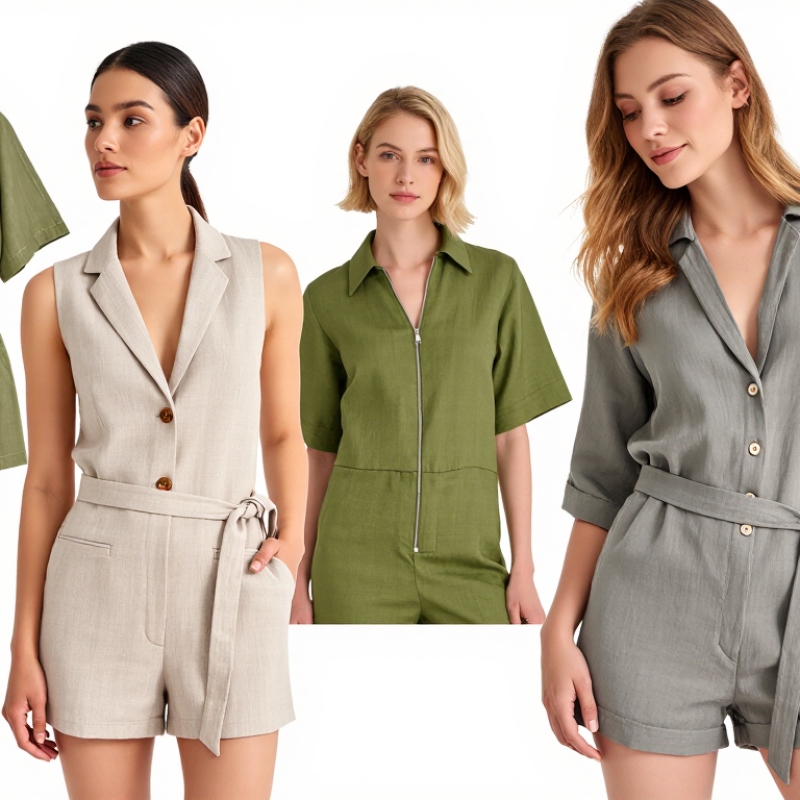
What Defines a Quality Linen Romper for Women?
A quality linen romper starts with the cloth, not the hangtag. The Alliance for European Flax-Linen and Hemp reports that Europe produces roughly 80% of the world’s long flax fibre. That origin figure speaks to supply, not garment quality. Feel the fabric. Good linen should feel breathable and substantial, without feeling stiff or paper-thin. Hold it against daylight; thin fabric may turn sheer across the seat or chest. A little slub is normal. Large weak spots are not.
Check the seams. Look for even stitching at the crotch, armholes, and pocket corners, where stress often shows first. Gently pull the fabric beside a seam; loose threads or obvious gaps deserve attention. For wholesale orders, request a sewn sample and wash it according to the care label. Linen can soften and change size after washing, so compare measurements before and after. Ask the supplier for fabric composition, garment measurements, and shrinkage test results. These details matter more than a polished product photo.
Fit needs practical testing. Sit, reach, and bend; the romper should not pull tightly across the back or ride up at the leg openings. Check whether the waist tie stays secure and pockets lie flat when filled with a phone. One detail is easy to miss: a roomy cut can still restrict movement if the rise is short. No single label proves quality. Judge the fabric, construction, and fit together.
Why Retailers Choose Linen Rompers for Wholesale
Retailers choose linen rompers wholesale because one garment can serve as an easy outfit, not just a seasonal trend. Linen’s breathable feel suits warm-weather shopping, while a one-piece design simplifies styling for customers who want fewer decisions. A neutral shade can pair with sandals, a woven bag, or a light shirt. That helps.
For store buyers, the appeal is practical, too. A small display needs little styling: hang a romper beside a belt and straw hat, then show how its tie waist adjusts the silhouette. Linen’s texture gives the rack a natural, tactile look. Check fabric weight, seam finishing, pocket placement, and whether the closure is easy to use. These details affect wearability more than a polished product photo can show.
There is a trade-off. Linen creases, and customers may see that relaxed finish as charming—or untidy. Not every shopper agrees. Before ordering in volume, compare measurements across samples. Check the garment’s appearance after sitting and washing it according to care instructions. Ask suppliers about restock timing and color consistency; a popular size disappearing mid-season can leave gaps.
Popular Styles and Features of Wholesale Linen Rompers
Wholesale linen rompers are selling through relaxed silhouettes with practical details. Buyers often favor wide legs, elastic waists, adjustable straps, and pockets deep enough for a phone. Button-front styles feel polished, while tie-waist designs allow easier fit adjustments. Natural flax texture gives each piece a slightly varied surface. Room to breathe. For warm-weather assortments, offer neutral shades alongside seasonal colors, and check that fabric weight suits the intended climate. A very light linen may feel airy but can show through; heavier cloth offers more coverage, with less drape.
Fabric sourcing matters. The Alliance for European Flax-Linen & Hemp reports that European flax producers supply roughly 80% of the world’s long flax fibre. That makes origin and traceability useful questions for wholesale buyers, though the statistic does not guarantee that a finished romper uses European flax. Request fibre-content details, garment measurements, seam and pocket photos, and wash-care guidance before placing a bulk order. Linen creases; buyers may see that as character, or as a drawback. It is worth checking customer expectations.
Tips: Order samples in two sizes. Test the waist, inseam, and opacity in daylight. Ask suppliers to confirm shrinkage after washing and whether each color is available in consistent quantities.
Top Linen Rompers for Wholesale: Fabric Weight by Style
Approximate linen fabric-weight ranges suited to different romper looks (grams per square meter, or GSM).
Lightweight linen works well for relaxed, breezy rompers; midweight fabric offers more structure for belted or button-front styles; heavier linen can suit utility-inspired designs. These are general fabric-weight ranges, and the final feel varies with weave, blend, and finish.
How to Evaluate Linen Rompers Before Placing a Bulk Order
Top Linen Rompers for Women to Buy Wholesale?
How to Evaluate Linen Rompers Before Placing a Bulk Order
Before ordering, confirm the fabric composition rather than relying on a “linen” label alone. Pure linen and linen blends can differ in drape, texture, and care needs. Ask for the fabric weight and a physical sample. Hold it against the light, rub the surface gently, and check whether the weave feels consistent. A soft hand is useful, but it does not guarantee durability.
Review the size chart against actual garment measurements, including the bust, waist, hip, and inseam. Request measurements across several sizes, not just the sample size. Check how the romper closes and whether the straps or waist can be adjusted. Small fit details matter. A polished sample is reassuring, but it cannot show how every unit will fit. That uncertainty deserves attention.
Inspect the seams, pockets, buttons, and zipper, if included. Check the seams. Look for loose threads, uneven stitching, or stress points near the crotch and armholes. Wash and air-dry the sample according to its care instructions, then measure it again for shrinkage and check for color changes. Before confirming quantities, agree on acceptable measurement variation, packing details, and how defects will be handled. Even careful checks cannot remove every risk, so keep your inspection notes and sample measurements for comparison when the bulk order arrives.
Where to Source Wholesale Linen Rompers for Women
Wholesale linen rompers are easiest to source through apparel wholesalers, garment manufacturers, and established business-to-business marketplaces. Trade fairs can also help you compare fabrics and finishes in person. Ask whether the supplier holds ready-to-ship stock or makes each order to specification. That difference affects minimum quantities and delivery times. Request a sample before committing.
Check the fabric details carefully. “Linen” may mean pure linen or a blend with cotton or viscose, and the feel can vary considerably. Ask for the fiber breakdown, fabric weight, care instructions, and available size measurements. A good supplier should explain how the garment is made and provide clear product specifications. Look closely at seams, buttonholes, waistband elastic, and pocket depth on the sample. Small details matter.
Photos can be flattering. Samples are more honest. Wash one according to its care label and note any shrinkage, color change, or wrinkling. Linen naturally creases, so decide whether that suits your customers rather than expecting a perfectly smooth finish. Compare the sample measurements with the supplier’s size chart, then confirm pricing, lead time, packaging, and reorder availability in writing. I would not skip this step, even when a low minimum order looks tempting. Some suppliers answer quickly but give vague fabric details; treat that as a reason to ask more questions.

 '
