Why Choose Inflatable Bubble Tents for Your Business?

Inflatable Bubble Tents can turn an open lawn, rooftop, or event space into a memorable place to stay. Their clear walls frame trees, evening lights, or a starry sky, giving guests a view that ordinary rooms cannot offer. For businesses, that visual appeal may support lodging, private dining, pop-up events, or branded experiences. The tent is not the whole business, though. Comfort, privacy, ventilation, weather planning, and reliable installation matter just as much. A beautiful photo cannot fix a stuffy night.

For this introduction, a clearly illustrative industry-expert voice, inflatable-structure consultant Maya Chen, offers this guiding thought: “A bubble tent earns its place when the guest experience is as carefully planned as the view.” That is a useful test, not a promise of easy returns. Operators should consider site access, power needs, cleaning routines, and how guests will feel when the weather changes. They should also check product specifications and ask suppliers about setup, maintenance, and support. Small details count: a firm floor beneath bare feet, a quiet fan, and a screen that closes smoothly. Some sites will suit bubble tents; others will not. This article explores the practical reasons businesses choose them, the trade-offs to weigh, and the questions worth asking before investing.
Why Choose Inflatable Bubble Tents for Your Business?

What Defines an Inflatable Bubble Tent and How Does It Work?

Why Choose Inflatable Bubble Tents for Your Business?

What Defines an Inflatable Bubble Tent and How Does It Work?

An inflatable bubble tent is a lightweight, air-supported shelter with clear panels that create a bright, open-feeling space. Unlike a rigid glass structure, it uses flexible fabric and transparent materials, often joined with reinforced seams. A blower supplies steady airflow to keep the frame upright. The exact design varies: some models use continuous air, while others rely on sealed chambers. Check the product specifications before planning an event.

For a business, the clear walls can help display products, host small gatherings, or create a sheltered viewing area. Imagine guests stepping inside from a breezy garden, with a clear view of the trees and soft daylight overhead. The setup is not effortless. You need a suitable power source, secure anchoring, and enough space around the entrance. Ventilation and condensation also deserve attention, especially when several people occupy the tent. It may feel warm or foggy on a humid day.

Tips: Test the blower and seams before opening to guests. Secure the tent according to its instructions, and keep the air intake clear. Bring a backup plan for power interruptions. A bubble tent can attract attention, but it still needs supervision and routine checks. One detail is easy to miss: clear panels show fingerprints and dust quickly, so allow time for cleaning.

Grand View Research: $3.4B Glamping Market and 10% Forecast CAGR

Grand View Research estimates the global glamping market reached $3.4 billion, with a forecast compound annual growth rate of about 10%. This signals expanding interest in outdoor stays that offer comfort without losing their connection to nature. It does not guarantee bookings. Demand still depends on location, season, pricing, and guest experience.

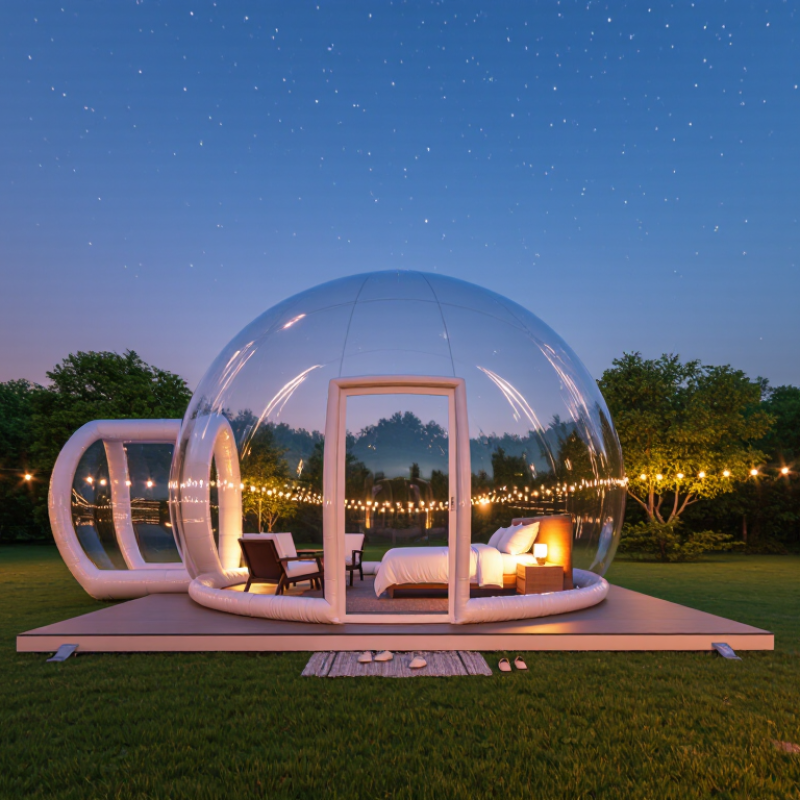
Inflatable bubble tents can help operators create memorable stays with wide views of trees, hills, or clear night skies. Their transparent panels make the setting part of the accommodation, while inflatable construction can simplify setup compared with some rigid structures. A warm-lit interior and a dry, level platform can make the space feel inviting. Small details matter.

The practical checks matter just as much. Operators should assess ventilation, privacy, condensation, cleaning, and local weather before investing. A clear roof may offer beautiful stargazing, but it can feel exposed during hot days or busy seasons. Not every site. Grand View Research’s market estimate supports considering the opportunity; it is not a substitute for local occupancy research, operating-cost estimates, or a trial setup. A pilot unit can reveal issues that brochures miss, including morning heat and noise from nearby paths.

How Bubble Tents Serve Lodging, Events, Dining, and Retail

Inflatable bubble tents give lodging operators a distinctive way to add rooms without building permanent structures. UN Tourism reported 1.4 billion international tourist arrivals in 2024, reaching 99% of 2019 levels. That recovery supports testing flexible guest spaces, though demand varies by location and season. A raised bed, warm lighting, and clear night-sky views can make a small site feel memorable. Comfort still matters more than novelty.

For events, transparent tents create sheltered spaces for workshops, photo areas, or private lounges while keeping guests connected to the venue. Dining operators can use them for seasonal seating. The National Restaurant Association’s 2024 industry report found that 45% of operators expected outdoor dining to become more important that year. A bubble tent can extend seating, but heat, airflow, and condensation need real attention. Guests notice quickly.

Retailers can turn a tent into a temporary showroom, product launch space, or quiet fitting area. Its shape draws attention; the interior should remain easy to navigate. Plan anchoring, ventilation, drainage, and clear exits with qualified site professionals. Weather protection is not weather-proofing. A clear dome can feel exposed, and that may not suit every customer. Test a small installation before committing to a larger setup.

Why Choose Inflatable Bubble Tents for Your Business? — How Bubble Tents Serve Lodging, Events, Dining, and Retail
Business Use Typical Setup Practical Capacity Business Benefits Planning Considerations
Lodging and Glamping A 5–6 m diameter tent provides approximately 20–28 m² of floor area before furnishings. Often suitable for 2–4 overnight guests, depending on bed size, furniture, and circulation space. Creates a distinctive guest experience and can provide a flexible accommodation option where site conditions allow. Plan for privacy, ventilation, temperature control, lighting, power, weather protection, and local accommodation and fire-safety requirements.
Events and Exhibitions A compact 4–5 m diameter tent can serve as a small activation space, information point, or sheltered display area. Capacity depends on the layout; standing guests, seating, equipment, and accessible routes all use floor space. The transparent enclosure can make displays visible and create a memorable focal point at suitable indoor or outdoor events. Check venue rules, wind limits, anchoring options, emergency exits, crowd flow, and any required permits before installation.
Dining and Hospitality A larger tent can be arranged with tables and chairs, or used as a covered extension to an existing hospitality space. Seating capacity varies with table size, service routes, and accessibility needs; allow room for guests and staff to move safely. Offers a distinctive dining setting and can help businesses create temporary or seasonal seating areas. Confirm ventilation, heating or cooling needs, food-service regulations, cleaning requirements, and safe separation from cooking equipment.
Retail and Product Display A small or medium tent can be arranged as a pop-up showroom, product demonstration area, or sheltered point of sale. Set capacity according to display fixtures, checkout space, stock storage, and customer circulation. Provides an eye-catching setting for launches, promotions, and temporary retail locations. Consider security, lighting, power access, payment connectivity, weather exposure, accessibility, and permissions for the site.
Setup and Operations Setup time and crew size depend on the tent model, anchoring method, site preparation, and equipment. Allow sufficient space around the tent for installation, access, and any required support equipment. Inflatable structures may be portable and reusable when designed for repeated deployment and maintained according to instructions. Follow the manufacturer’s setup and operating guidance; inspect the site and check local safety rules, weather conditions, and insurance requirements.
Note: Dimensions and capacities are indicative planning examples, not guaranteed specifications. Actual usable space and suitability depend on the tent design, furnishings, site, weather, applicable regulations, and the manufacturer’s guidance.

Which Setup, Power, Weather, and Maintenance Requirements Matter?

An inflatable bubble tent can create a memorable viewing space, but the site must work as well as the design. Check the footprint, overhead clearance, ground slope, and access route before delivery. Leave room for anchoring and for visitors to enter without crowding the blower or cables. A smooth lawn may look suitable, yet hidden stones or sharp edges can damage the base. Test it early.

The blower usually needs a steady power supply while the tent is inflated. Confirm the required voltage and circuit capacity with the supplier, then place connections away from foot traffic and standing water. Plan for cable covers or a protected power source where appropriate. Keep a backup plan for outages; a tent that slowly loses pressure is not a minor inconvenience during a busy event.

Weather limits deserve careful attention. Wind, heavy rain, heat, and sudden temperature shifts can affect comfort and stability. Follow the tent’s operating guidance, secure it using suitable anchors, and pause use when conditions exceed its limits. Weather changes quickly. For maintenance, inspect seams, anchor points, windows, and blower connections before each use. Clean surfaces with materials approved for the fabric, and dry the tent fully before storage to reduce mildew risk. It is easy to rush packing after an event; that shortcut can create more work later.

How to Assess Safety Standards, Supplier Quality, and Business ROI

An inflatable bubble tent can create a distinctive guest experience, but safety claims need evidence. Ask suppliers for documented fabric fire-performance results, seam-strength data, and clear wind and weather operating limits. Requirements vary by location, so confirm applicable standards with qualified local professionals before installation. Do not rely on a glossy product sheet. Request inspection records, setup instructions, and details on keeping exits clear. Small details matter.

Supplier quality shows in the seams, valves, zippers, and after-sales support. Ask to inspect a sample or see one inflated, then check how repairs are handled and which parts are replaceable. A fast, specific answer is useful; a vague promise is not. I would also compare written specifications against the delivered unit. Mistakes happen, and a checklist helps catch them early. For business ROI, estimate realistic bookings, setup labor, transport, cleaning, storage, and seasonal downtime. Compare those costs with expected revenue per usable night, not the most optimistic forecast. A tent that takes extra staff to anchor or dry may look less profitable in practice. Track setup time and maintenance during a trial period, even if the first figures are imperfect.

Why Choose Inflatable Bubble Tents for Your Business?

Assess safety documentation and supplier quality first, then compare the tent’s expected contribution with its total cost.

Reading the chart: ASTM E84 flame-spread classes are commonly stated as Class A: 0–25, Class B: 26–75, and Class C: 76–200. These are classification thresholds, not a guarantee that a particular tent complies with local requirements. Ask suppliers for current test reports covering the exact fabric and coatings, and verify applicable fire, anchoring, and weather-safety requirements for your location and use.

Supplier quality and ROI: Check material specifications, seams, anchoring instructions, repair support, warranty terms, and documentation. Estimate payback using total purchase and operating costs divided by net contribution per booking; use your own quoted costs, booking rate, and revenue rather than general industry assumptions.

'