A room divider curtain can turn one open area into two useful zones without adding a permanent wall. It may soften a bright window, create a quieter sleeping corner, or give a work desk a little privacy. The right choice depends on how you use the room, not just which fabric looks attractive online.
Small details matter. Measure the full span and ceiling height, then check whether your rod or ceiling track can support the curtain’s weight. Consider how much light and visibility you want to keep. A sheer panel feels airy, while a lined or heavier fabric offers more coverage. Think about opening space, too; gathered curtains need somewhere to stack. Easy to overlook.
These seven tips will help you compare fabric, opacity, hanging systems, color, and care needs before you buy. They also cover practical questions, such as whether the divider will move smoothly and how it may affect the room’s light. Product descriptions can be useful, but they do not always show how a curtain hangs in your exact space. Even careful measuring can miss a detail, like a ceiling beam or a vent. A second check is worth the pause.
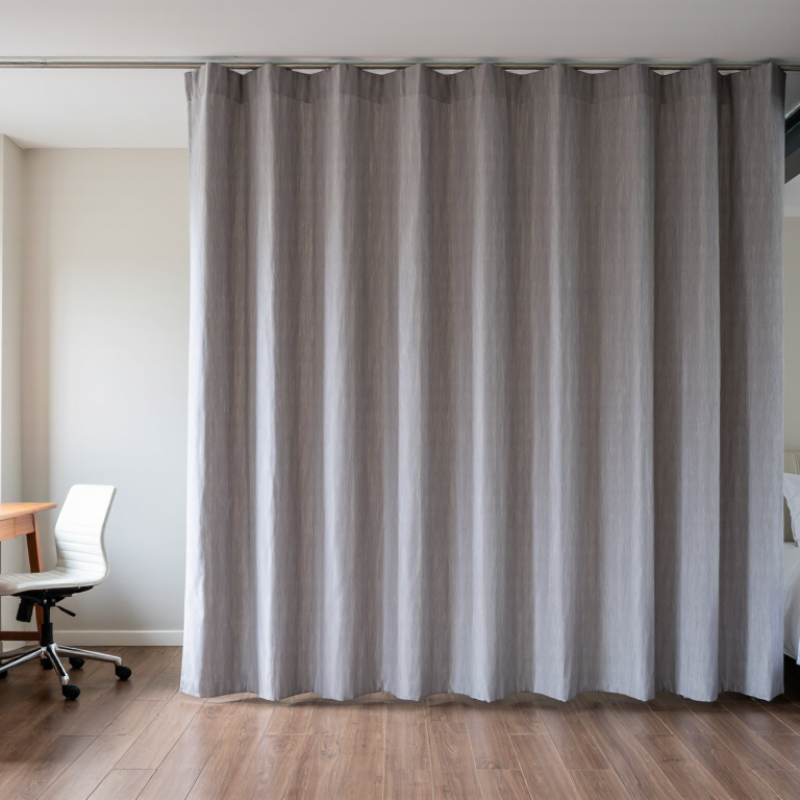
Before choosing fabric, decide what the divider must control. For a bedroom nook, privacy after dark may matter more than daytime light. In a shared living area, a sheer panel can soften glare while keeping the space visually open. Test it at night. Some fabrics look opaque by day but reveal silhouettes when a lamp is on.
Airflow deserves its own check. A curtain is not a ventilation system, and a floor-length, tightly woven panel can slow air movement between zones. The U.S. Environmental Protection Agency’s indoor-air guide reports that concentrations of some pollutants are often two to five times higher indoors than outdoors. Keep vents clear, and leave a gap above or beside the curtain if air needs to circulate. Air needs room.
Light needs may change by time of day. The U.S. Department of Energy reports that LED bulbs use at least 75% less energy than incandescent bulbs, so a light-filtering curtain paired with efficient task lighting can work well after sunset. Measure the window, note where sunlight lands, and consider how the fabric behaves when backlit. A mistake is choosing by color alone; texture and lining can alter both brightness and privacy. Make a small fabric sample test before committing.
A room divider curtain can soften a shared space, but its track and fabric need careful measuring. Measure the full span from wall to wall, then check ceiling height and nearby fixtures. A tape measure and a helper can prevent a crooked track or a curtain that drags across the floor. Measure twice.
Where a 36-inch ADA route is required, keep that width clear after the curtain is installed. Measure the usable passage between the curtain, furniture, and other fixed objects—not just the gap shown on a floor plan. Account for fabric that bunches at the side when open. A curtain stack can quietly narrow the route. Requirements may depend on the space, so verify the applicable accessibility rules before installation.
Try marking the proposed track and open-curtain position with painter’s tape. Walk the route with a bag or cart to notice tight turns and snag points. I have found that a plan can look roomy on paper and feel awkward in use. That is worth reconsidering before drilling holes. If the available span cannot preserve the required clear width, choose a different curtain position or divider layout.
A room-divider curtain must balance privacy, light, and fire safety. Sheer fabric softens a room but leaves silhouettes visible when the space behind it is lit. Blackout fabric blocks more light, while a medium-weight, tightly woven curtain often offers a practical middle ground. Check samples in both daylight and evening light; opacity can look different against a bright window. Heavier fabric may hang smoothly, but it also needs stronger supports.
Tip: Ask for the NFPA 701 test report. NFPA 701 specifies methods for testing flame propagation in textiles and films; it does not mean a curtain is fireproof. Confirm the report covers the exact fabric, backing, and treatment you plan to buy. A claim on a product page alone may not show what was tested.
The broader safety context matters: NFPA’s report, “U.S. Fire Experience in 2023,” estimates 1,389,000 fires responded to by U.S. fire departments that year. That figure covers all reported fires, not curtain-related incidents, but it underscores why documentation matters. Check the selvage. Also weigh the curtain in your hands: dense fabric can sag on a light track, and a lighter option may shift in a draft. One trade-off is easy to miss: coatings can change both the feel and drape, so request a sample and written test details before installation.
When comparing room divider curtains, look for test results tied to ASTM C423, a method for measuring sound absorption in a reverberation room. The resulting Noise Reduction Coefficient, or NRC, summarizes absorption at 250, 500, 1,000, and 2,000 Hz. It is not a soundproofing score. A higher NRC suggests the material absorbs more sound in that test, but it does not show how much sound passes through a curtain or around its edges. That distinction matters.
Read beyond the headline number. Check whether the report identifies the curtain’s fabric, dimensions, fullness, and mounting method. A pleated sample suspended with an air gap may perform differently from a flat curtain hung close to a wall. Ask for frequency-by-frequency results when available; speech, low voices, and hallway noise do not occupy identical ranges.
Also consider the room itself. Hard floors and bare walls can keep a space lively, even with an absorbing curtain. I would treat NRC as a useful clue, not a promise. Real rooms are messier than test chambers.
If a seller offers only vague “noise reduction” language without a test method or setup details, the claim is difficult to compare reliably.
Choose a mounting system around the room’s daily rhythm. For a divider opened every morning, a ceiling track with smooth gliders is usually easier than rings that catch and clatter. Check the ceiling material, joist locations, and curtain weight before drilling; a full-length panel can pull hard when children or pets brush past. If you rent, use a tension rod only when the span and fabric weight fall within its rated limits. It may sag. Measure twice, especially around door swings and floor vents.
Care matters as much as hardware. The U.S. Department of Energy estimates that windows account for about 25–30% of residential heating and cooling energy use. A divider is not a substitute for insulated window coverings, but a closely fitted curtain can help limit drafts between zones. Leave enough clearance for airflow, and avoid trapping damp fabric against a cold wall. Check the care label before washing: lined or coated fabrics may lose shape or finish in a machine. Vacuum dusty folds with a soft brush attachment, then spot-test cleaner on a hidden hem. I might choose washable fabric for a busy room, though frequent washing can shorten its life. A little compromise is unavoidable.
We now offer custom-made commercial vehicle tarps, along with the ability to design your own curtains, noise panels, and strip doors—tailored to your exact needs!
At Singer Safety, we specialize in manufacturing high-performance tarps engineered to safely secure and protect your vehicle loads during transport.