China Best Acoustic Foam Manufacturer for Global Buyers

“We are losing our listening,” sound expert Julian Treasure has warned. For global buyers, that reminder makes acoustic foam more than a product specification. The right choice starts with listening to the room: its echo, background noise, and intended use. A meeting room with sharp reflections needs a different treatment from a podcast booth or music space. The distinction matters.

This guide introduces how to assess an acoustic foam manufacturer for quality, customization, and dependable export support. Buyers should look beyond color, panel shape, and price. Ask for clear product specifications, test documentation, and installation guidance. Check whether the foam’s density, thickness, and surface profile suit your application. Also confirm packaging details, sample availability, and communication during production. These practical checks can prevent costly surprises.

Foam has limits. It can absorb some reflected sound, but it does not block all outside noise or fix every room problem. That is easy to overlook. A reliable supplier should explain those limits plainly, not promise silence. The sections ahead outline material options, performance questions, supplier evaluation, and the details global buyers should verify before placing an order. Use them as a starting point, then compare evidence against your room’s actual needs. The best choice is not always the thickest panel or the lowest quote. It is the one supported by clear information and a realistic plan.
China Best Acoustic Foam Manufacturer for Global Buyers

What Acoustic Foam Is and How It Controls Sound

Acoustic foam is a porous, open-cell material designed to absorb sound reflections inside a room. Sound waves enter its small pores, where friction converts some acoustic energy into heat. Less energy returns to the room as echo. It helps make speech clearer, but it does not seal doors or stop sound passing through walls. That distinction matters. A foam panel may soften a sharp voice while a neighbor can still hear it.

Professional test reports using ASTM C423 measure sound absorption at different frequencies. The Noise Reduction Coefficient, or NRC, is a rounded average of results at 250, 500, 1,000, and 2,000 Hz. One number can hide weak low-frequency performance, so buyers should check frequency-by-frequency data. A thin panel may tame handclaps but do little for a bass-heavy hum.

Room goals matter too. ANSI/ASA S12.60-2010/Part 1 sets a 0.6-second reverberation-time limit for certain furnished classrooms up to 10,000 cubic feet. This is a useful reference, not a universal target. A small office, studio, and dining room behave differently. Measure the room, identify the dominant reflections, and compare tested absorption data before choosing panel thickness or coverage. Foam is helpful, but it is not a cure-all.

Key Products and Applications Offered by Chinese Manufacturers

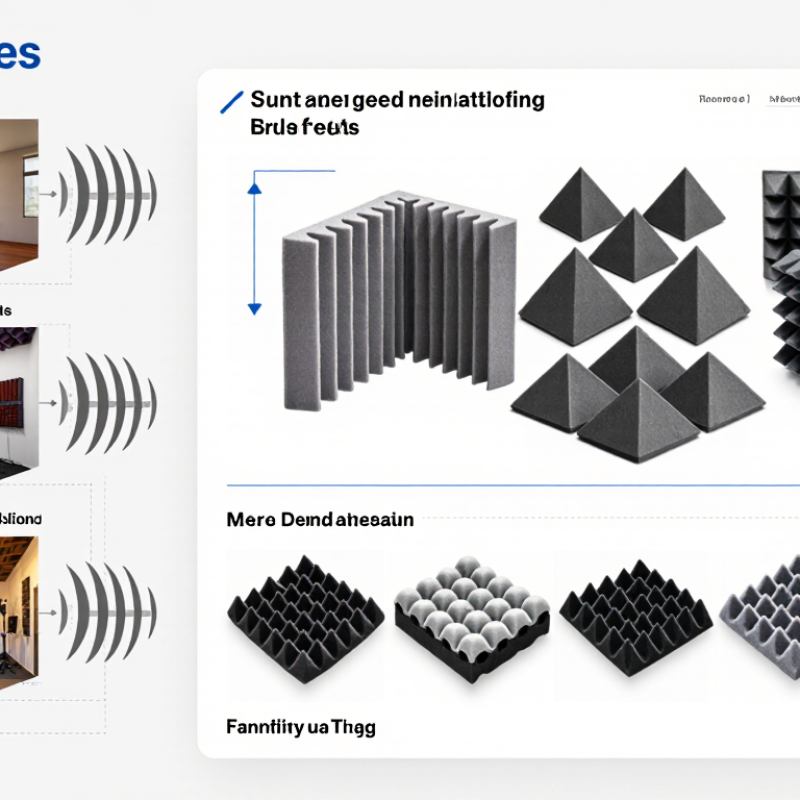
Chinese acoustic foam manufacturers commonly offer polyurethane foam sheets, wedge and pyramid profiles, polyester fiber panels, and thicker corner bass traps. Each serves a different acoustic task. Foam can reduce flutter echo and harsh reflections, while dense corner units help manage low-frequency buildup in small rooms. They do not replace sound isolation; noise can still pass through walls and doors.

For recording rooms, buyers often combine wall panels with ceiling clouds above the listening or microphone area. Offices may use fabric-wrapped panels to soften speech reflections in meeting rooms and open workspaces. Workshops and equipment rooms can benefit from practical, easy-to-clean surfaces, but material choice depends on dust, humidity, and nearby heat sources. Small details matter. A panel placed behind a monitor may help, yet untreated corners can remain troublesome.

Manufacturers may also provide cut-to-size panels, adhesive-backed sheets, or custom shapes for transport interiors and commercial spaces. Ask for thickness, density, test methods, and available fire-performance documentation before comparing quotations. Samples reveal texture and odor, but they cannot show how a full room will sound. That part is less tidy. Measure the space, note the main noise problem, and request guidance based on the actual installation rather than appearance alone.

How Acoustic Foam Is Made and Quality Standards Are Verified

China Best Acoustic Foam Manufacturer for Global Buyers

How Acoustic Foam Is Made and Quality Standards Are Verified

Acoustic foam starts with carefully measured raw materials, often polyurethane or melamine compounds. For open-cell foam, the cellular structure allows air to pass through and helps absorb sound energy. Mixing, curing, and cutting shape the material into sheets, wedges, or other profiles. Operators check foam density, thickness, and surface consistency during production. Small changes matter. A slightly uneven cut can complicate installation, even when the material performs well in a test.

Quality checks begin with batch records and dimensional measurements. Technicians may inspect cell structure, density, and compression recovery, then send samples for sound absorption testing in an appropriate laboratory. Fire performance should also be verified against the buyer’s stated requirements and intended market; one test result does not automatically apply everywhere. Keep records. Test reports should identify the sample, method, and production batch so buyers can trace the results. A clean laboratory result can still differ from performance in a finished room, where mounting, air gaps, and surface coverage affect absorption. Buyers should compare documented test data with the installation plan, not rely on appearance alone.

How Global Buyers Can Assess Chinese Acoustic Foam Suppliers

Global buyers should assess Chinese acoustic foam suppliers through evidence, not polished product photos. Grand View Research valued the global acoustic insulation market at about USD 15.1 billion in 2023. That figure covers multiple insulation materials, not foam alone, so it signals demand—not supplier quality. Ask for independent test reports showing the foam’s thickness, density, mounting method, and absorption results by frequency. ASTM C423 and ISO 354 describe recognized reverberation-room testing methods. A single NRC figure is useful, but it can hide weak performance at particular frequencies. Numbers matter.

Check whether sample specifications match the production batch. Request documented checks for dimensions, density, and packaging, then compare a retained sample with delivered goods. Ask how the supplier handles variation between batches, and request current fire-performance and emissions documentation relevant to your project. Verify the lab, test date, and tested product details; a report for a different formulation proves little. Small details matter. A supplier may answer every question quickly yet provide incomplete records. That is not automatic grounds for rejection, but it deserves follow-up. Allow time for samples, repeat measurements, and a written review before placing a large order.

China Best Acoustic Foam Manufacturer for Global Buyers - How Global Buyers Can Assess Chinese Acoustic Foam Suppliers

A practical supplier-evaluation table for comparing acoustic foam products, documentation, quality controls, and export readiness. Confirm requirements against the destination market and intended application.

Assessment Dimension What to Check Evidence to Request Buyer Decision Guide
Product and material identification Confirm foam type, stated polymer, density, thickness, surface profile, color, and intended use. Check that the quotation, sample, and product specification describe the same item. A dated technical data sheet, product drawings or profile dimensions, and a sample labeled with the corresponding item code. Proceed when the specification is complete and consistent. Clarify any undefined material, dimension, or product-code differences before ordering.
Acoustic performance Review sound-absorption data for the exact product and test setup. Results can vary with thickness, mounting, air gap, and test method; an absorption rating does not by itself describe sound blocking. A test report identifying the sample, test method, mounting conditions, frequency-band results, laboratory, and test date. Relevant methods may include ASTM C423 or ISO 354. Compare reports only when product construction and test conditions are comparable. Request a test on the intended configuration if the report does not match it.
Fire performance Identify the fire-test and classification requirements for the product’s destination and end use. Do not assume that a result under one standard satisfies another market’s requirements. A current report or certificate for the specified formulation and product, including the standard, classification, specimen details, and issuing laboratory. Accept only documentation that matches the required market, use, and supplied material. Confirm whether the requirement applies to the foam alone or the complete assembly.
Restricted substances and market compliance Determine which chemical or product regulations apply in the destination country and to the intended use. Requirements differ by market and product category. Applicable declarations, test reports, or material disclosures that identify the product covered and the relevant regulation or standard. Check scope, issue date, and product identity. Treat a general compliance statement as insufficient if it does not identify the applicable requirement and product.
Dimensional and batch consistency Agree on tolerances for thickness, length, width, profile, and any cut features. Ask how incoming materials and finished goods are checked. A written specification with agreed tolerances, inspection records from a sample order, and a description of the supplier’s batch-identification process. Approve tolerances before production. Confirm that inspection records trace to the relevant production batch and purchase specification.
Sample and production match Evaluate the sample for appearance, dimensions, odor, handling, and fit for the intended installation. Confirm that mass production will use the approved specification. A signed or otherwise clearly identified reference sample, approved drawings or specification, and a written change-notification process. Keep a record of the approved sample and specification. Require notice and approval before changes to material, process, or dimensions.
Quality-control process Ask how the supplier checks raw materials, production settings, finished dimensions, appearance, packaging, and nonconforming goods. A quality-control plan, sample inspection checklist, example inspection report, and explanation of corrective-action handling. Look for defined inspection points, recorded results, and a clear process for containment and correction when a check fails.
Production capacity and lead time Confirm the available process, order quantity requirements, production schedule, and factors that could affect delivery. Capacity should be assessed against the buyer’s own order size and timing. A written quotation stating quantity, production lead time, order assumptions, and shipment terms; request a production plan for larger or time-sensitive orders. Compare like-for-like quantities and delivery terms. Treat lead times as commitments to confirm in the purchase order, not as general estimates.
Packaging and transport suitability Check protection against moisture, dirt, compression damage, and handling during the planned transport route. Confirm carton dimensions, labeling, and packing quantity. Packaging specifications, photographs or a packing sample, carton measurements, and a packing list format. Confirm packaging and labeling requirements before production. For compressed or rolled products, agree on handling and unpacking instructions where relevant.
Export and shipment documentation Confirm that the supplier can prepare documents required for the agreed shipment and destination. Requirements depend on the transaction, transport mode, and importing country. A proposed commercial invoice, packing list, and any other agreed shipping or product documents, with product descriptions consistent across documents. Review document details before shipment, including quantities, descriptions, consignee information, and agreed trade terms.
Commercial terms and after-sales handling Review payment terms, quotation validity, ownership of tooling or artwork where applicable, warranty scope, claims process, and responsibility for inspection or rework. A written quotation and purchase terms covering specifications, acceptance criteria, delivery, payment, claims, and remedies for nonconforming goods. Resolve exclusions and responsibilities in writing before placing the order. Use the same agreed specification in the purchase order and quality documents.

Evaluation note: There is no single acoustic, fire, or compliance threshold that applies to every foam product and market. Set acceptance criteria for the intended application, verify documents against the exact product supplied, and use independent testing when the purchase risk or regulatory requirement warrants it.

Export, Customization, and Logistics Considerations for International Orders

For international buyers, export planning starts before production. Acoustic foam is light but bulky, so carton dimensions can affect freight costs as much as product weight. UNCTAD’s Review of Maritime Transport 2024 reports that more than 80% of world trade by volume moves by sea. That makes container loading, moisture protection, and delivery buffers practical concerns. Ask the manufacturer for carton measurements, loading plans, and clear production and transit estimates. Small details matter.

Customization should be documented in measurable terms: foam type, thickness, density, surface profile, color, and cut dimensions. Request a pre-production sample and confirm how the material should be packed; compression may alter its shape after unpacking. Destination requirements vary, so buyers should verify applicable product and labeling standards with qualified local advisers. The World Bank’s Logistics Performance Index 2023 compares 139 economies across six areas, including customs, infrastructure, and shipment timeliness. It is a useful reminder that delivery reliability depends on more than the factory. One awkward point: a sample cannot reveal every transit problem. Test packaging, too, and leave time for inspection before installation.

'