
How to Choose the Best Acoustic Foam?
Acoustic foam can make a room sound less harsh, but choosing it by color or price alone often leads to disappointment. A small studio with sharp vocal reflections has different needs from a large rehearsal room or a home office beside a busy street. The right choice depends on the room, the sound problem, and where panels can be placed. Not just appearance.
This guide explains how to compare foam thickness, shape, density, and documented absorption ratings. It also considers panel coverage and placement, since a few panels at reflection points may help more than covering every wall. Check product specifications carefully: “soundproof” is not the same as reducing echo, and foam usually does little to block noise passing through walls. That distinction matters.
For practical decisions, start with a simple room assessment. Clap near a hard wall, listen for ringing, and note where voices sound most reflective. A desk facing a bare wall may need different treatment from a room with a lively ceiling. Then match the product to the problem, while keeping ventilation, secure installation, and the manufacturer’s fire guidance in view. Ratings can help, but testing conditions may differ from your room. That is easy to overlook. A measured approach is usually more reliable than buying the thickest option available, though no single formula fits every space. A little trial and adjustment may still be needed.
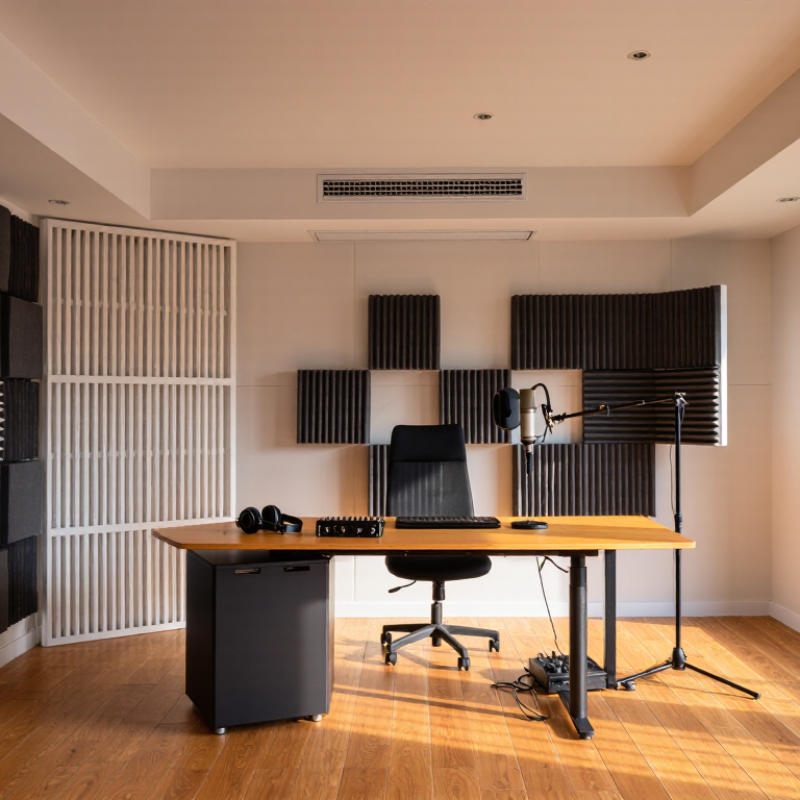
Define the Noise Problem and Target Frequencies Before Choosing Foam
Before choosing acoustic foam, identify what you hear and where it occurs. A sharp hand clap that lingers suggests reflections in the room. A steady low rumble may come from a fan, traffic, or room resonance instead. These problems need different treatments. Start here.
Listen from several seats, not only beside the wall. Note whether speech sounds harsh, hollow, or simply too loud. A phone recording or spectrum app can offer clues, but neither replaces careful listening. Foam mainly reduces reflected mid- and high-frequency sound; it will not block noise passing through a wall. I once assumed a thicker panel would solve a bass problem. It did not. That distinction is easy to miss.
If low notes build up near corners, measure or compare them at different points in the room before buying anything. Bass traps or changes to the room may be more suitable than thin foam. For fluttering echoes or bright reflections, treat likely reflection points, such as bare side walls near a desk. Add a small amount, then listen again with familiar speech or music. Too much absorption can make a room sound unnaturally dull. Measurements help, but placement still deserves a second look.
How to Choose the Best Acoustic Foam? — Define the Noise Problem and Target Frequencies Before Choosing Foam
| Noise or Room Problem | Typical Frequency Range | What to Address First | Suitable Acoustic Treatment | Placement Guidance | Important Limitation |
|---|---|---|---|---|---|
| Speech echo in a small meeting or recording room | Speech fundamentals are commonly around 85–255 Hz for adult voices; speech clarity also depends on harmonics and consonants extending into several kilohertz. | Reduce reflections that make voices sound hollow or blurred. | Porous acoustic foam or other porous absorbers, typically about 25–50 mm thick for useful mid- and high-frequency absorption. | Place panels at reflection points on walls and, where appropriate, the ceiling. Leave some wall area untreated to avoid an overly “dead” sound. | Thin foam mainly absorbs mid and high frequencies; it does not provide substantial isolation from sound passing through walls. |
| High-frequency flutter echo or sharp room reflections | Often most noticeable above roughly 1,000 Hz, though the exact range depends on the room and surfaces. | Identify parallel reflective surfaces and strong early reflections. | Porous foam panels or other absorptive panels; thinner products are generally more effective at higher frequencies than at bass frequencies. | Use a mirror or a listening test to locate reflection points on opposing walls and near the ceiling. | Covering only one small area may not resolve reflections from other untreated surfaces. |
| Boomy bass or uneven low notes in a listening room | Usually associated with room modes in the low-frequency region; the affected frequencies depend on room dimensions. | Measure or identify the problem frequencies and consider room dimensions and speaker/listener positions. | Thick porous absorbers or purpose-designed bass traps; greater depth and an air gap behind the absorber can improve low-frequency absorption. | Start in corners and other locations where low-frequency pressure is strong, then recheck the room response. | Thin decorative foam is generally ineffective at controlling deep bass. Treatment cannot correct every room-mode null at a listening position. |
| Low hum from equipment or building services | Common electrical hum components occur at 50 or 60 Hz and sometimes at their harmonics, depending on the power system and source. | Find and, if possible, reduce the source of the vibration or hum. | Source repair, vibration isolation, or an engineered enclosure may be more relevant than wall foam. | Inspect the equipment, mounts, ducts, and connected structures before adding room treatment. | Acoustic foam is not a practical fix for a persistent low-frequency hum and does not block sound transmission. |
| Traffic noise entering through a window or exterior wall | Broadband noise, often containing low-frequency engine and tire components as well as mid- and high-frequency sound. | Locate the transmission path, such as gaps, glazing, doors, or a lightweight wall. | Improve airtightness and use suitable building or window sound-isolation measures; use room absorbers only to reduce indoor reflections. | Seal appropriate gaps and assess the window or wall assembly. Add interior absorption if the room itself sounds reverberant. | Foam attached to an interior surface does not replace mass, airtightness, or construction measures needed for sound isolation. |
| Room sounds harsh after adding hard flooring or furniture | Often most noticeable in the mid and high frequencies; the overall result depends on the room’s size and furnishings. | Balance reverberation and reflections rather than trying to eliminate all room sound. | Use a mix of absorptive surfaces, such as wall panels, curtains, rugs, or upholstered furnishings, selected for the room and use. | Distribute treatment across several surfaces instead of concentrating every panel in one location. | Too much absorption can make a room sound unnaturally dull; choose treatment according to the intended use. |
Selection note: Frequency ranges are approximate, and performance varies with product thickness, density, mounting method, air gap, and test conditions. Compare published absorption data across frequency bands when available; a single rating such as NRC does not describe low-frequency performance in detail. Acoustic absorption reduces reflections inside a room, while sound isolation requires controlling transmission through the building structure.
Related Posts
-
China Best Acoustic Foam Manufacturer for Global Buyers
-
How to Choose the Right Acoustic Foam for Your Needs?
-
Unlocking Acoustic Perfection: Why Soundproof Foam is Your Best Investment for Noise Reduction
-

How to Choose the Best Soundproof Foam for Your Needs?
-
How to Choose the Best Plastic Strip Curtains for Your Business?
-
2026 Best Sound Proof Panels for Superior Noise Reduction?
 '
